Chapter 2 The TEI Header
This chapter addresses the problems of describing an encoded work so that the text itself, its source, its encoding, and its revisions are all thoroughly documented. Such documentation is equally necessary for scholars using the texts, for software processing them, and for cataloguers in libraries and archives. Together these descriptions and declarations provide an electronic analogue to the title page attached to a printed work. They also constitute an equivalent for the content of the code books or introductory manuals customarily accompanying electronic data sets.
Every TEI-conformant text must carry such a set of descriptions, prefixed to it and encoded as described in this chapter. The set is known as the TEI header, tagged teiHeader, and has five major parts:
- a file description, tagged fileDesc, containing a full bibliographical description of the computer file itself, from which a user of the text could derive a proper bibliographic citation, or which a librarian or archivist could use in creating a catalogue entry recording its presence within a library or archive. The term computer file here is to be understood as referring to the whole entity or document described by the header, even when this is stored in several distinct operating system files. The file description also includes information about the source or sources from which the electronic document was derived. The TEI elements used to encode the file description are described in section The File Description below.
- an encoding description, tagged encodingDesc, which describes the relationship between an electronic text and its source or sources. It allows for detailed description of whether (or how) the text was normalized during transcription, how the encoder resolved ambiguities in the source, what levels of encoding or analysis were applied, and similar matters. The TEI elements used to encode the encoding description are described in section The Encoding Description below.
- a text profile, tagged profileDesc, containing classificatory and contextual information about the text, such as its subject matter, the situation in which it was produced, the individuals described by or participating in producing it, and so forth. Such a text profile is of particular use in highly structured composite texts such as corpora or language collections, where it is often highly desirable to enforce a controlled descriptive vocabulary or to perform retrievals from a body of text in terms of text type or origin. The text profile may however be of use in any form of automatic text processing. The TEI elements used to encode the profile description are described in section The Profile Description below.
- a container element, tagged xenoData, which allows easy inclusion of metadata from non-TEI schemes (i.e., other than elements in the TEI namespace). For example, the MARC record for the encoded document might be included using MARCXML or MODS. A simple set of metadata for harvesting might be included encoded in Dublin Core.
- a revision history, tagged revisionDesc, which allows the encoder to provide a history of changes made during the development of the electronic text. The revision history is important for version control and for resolving questions about the history of a file. The TEI elements used to encode the revision description are described in section The Revision Description below.
A TEI header can be a very large and complex object, or it may be a very simple one. Some application areas (for example, the construction of language corpora and the transcription of spoken texts) may require more specialized and detailed information than others. The present proposals therefore define both a core set of elements (all of which may be used without formality in any TEI header) and some additional elements which become available within the header as the result of including additional specialized modules within the schema. When the module for language corpora (described in chapter Language Corpora) is in use, for example, several additional elements are available, as further detailed in that chapter.
The next section of the present chapter briefly introduces the overall structure of the header and the kinds of data it may contain. This is followed by a detailed description of all the constituent elements which may be used in the core header. Section Minimal and Recommended Headers, at the end of the present chapter, discusses the recommended content of a minimal TEI header and its relation to standard library cataloguing practices.
2.1 Organization of the TEI Header
2.1.1 The TEI Header and Its Components
The teiHeader element should be clearly distinguished from the front matter of the text itself (for which see section Front Matter). A composite text, such as a corpus or collection, may contain several headers, as further discussed below. In the general case, however, a TEI-conformant text will contain a single teiHeader element, followed by a single text or facsimile element, or both.
The header element has the following description:
- teiHeader (TEI header) supplies descriptive and declarative metadata associated with a digital resource or set of resources.
As discussed above, the teiHeader element has five principal components:
- fileDesc (file description) contains a full bibliographic description of an electronic file.
- encodingDesc (encoding description) documents the relationship between an electronic text and the source or sources from which it was derived.
- profileDesc (text-profile description) provides a detailed description of non-bibliographic aspects of a text, specifically the languages and sublanguages used, the situation in which it was produced, the participants and their setting.
- xenoData (non-TEI metadata) provides a container element into which metadata in non-TEI formats may be placed.
- revisionDesc (revision description) summarizes the revision history for a file.
Of these, only the fileDesc element is required in all TEI headers; the others are optional. That is, only one of the five components of the TEI header (the fileDesc) is mandatory, and it also has some mandatory components, as further discussed in The File Description below. The smallest possible valid TEI header thus looks like this:
<teiHeader>
  <fileDesc>
    <titleStmt>
      <title>
        <!-- title of the resource -->
      </title>
    </titleStmt>
    <publicationStmt>
      <p>
        <!-- Information about distribution of the resource -->
      </p>
    </publicationStmt>
    <sourceDesc>
      <p>
        <!-- Information about source from which the resource derives -->
      </p>
    </sourceDesc>
  </fileDesc>
</teiHeader>
The content of the elements making up a TEI header may be given in any language, not necessarily that of the text to which the header applies, and not necessarily English. As elsewhere, the @xml:lang attribute should be used at an appropriate level to specify the language. For example, in the following schematic example, an English text has been given a French header:
<TEI>
  <teiHeader xml:lang="fr">
    <!-- ... -->
  </teiHeader>
  <text xml:lang="en">
    <!-- ... -->
  </text>
</TEI>
In the case of language corpora or collections, it may be desirable to record header information either at the level of the individual components in the corpus or collection, or at the level of the corpus or collection itself (more details concerning the tagging of composite texts are given in section Language Corpora, which should be read in conjunction with the current chapter). A corpus may thus take the form:
<teiCorpus>
  <teiHeader>
    <!-- corpus-level metadata here -->
  </teiHeader>
  <TEI>
    <teiHeader>
      <!-- metadata specific to this text here -->
    </teiHeader>
    <text>
      <!-- ... -->
    </text>
  </TEI>
  <TEI>
    <teiHeader>
      <!-- metadata specific to this text here -->
    </teiHeader>
    <text>
      <!-- ... -->
    </text>
  </TEI>
</teiCorpus>
2.1.2 Types of Content in the TEI Header
The elements occurring within the TEI header may contain several types of content; the following list indicates how these types of content are described in the following sections:
- free prose
- Most elements contain simple running prose at some level. Many elements may contain either prose (possibly organized into paragraphs) or more specific elements, which themselves contain prose. In this chapter's descriptions of element content, the phrase prose description should be understood to imply a series of paragraphs, each marked as a p element. The word phrase, by contrast, should be understood to imply character data, interspersed as need be with phrase-level elements, but not organized into paragraphs. For more information on paragraphs, highlighted phrases, lists, etc., see section Paragraphs.
- grouping elements
- Elements whose names end with the suffix Stmt (e.g. editionStmt, titleStmt) and the xenoData element enclose a group of specialized elements recording some structured information. In the case of the bibliographic elements, the suffix Stmt is used in names of elements corresponding to the areas of the International Standard Bibliographic Description.1 In the case of the xenoData element, the specialized elements are not TEI elements, but rather come from some other metadata scheme. In most cases grouping elements may contain prose descriptions as an alternative to the set of specialized elements, thus allowing the encoder to choose whether or not the information concerned should be presented in a structured form or in prose.
- declarations
- Elements whose names end with the suffix Decl (e.g. tagsDecl, refsDecl) enclose information about specific encoding practices applied in the electronic text; often these practices are described in coded form. Typically, such information takes the form of a series of declarations, identifying a code with some more complex structure or description. A declaration which applies to more than one text or division of a text need not be repeated in the header of each such text or subdivision. Instead, the @decls attribute of each text (or subdivision of the text) to which the declaration applies may be used to supply a cross-reference to it, as further described in section Associating Contextual Information with a Text.
- descriptions
- Elements whose names end with the suffix Desc (e.g. settingDesc, projectDesc) contain a prose description, possibly, but not necessarily, organized under some specific headings by suggested sub-elements.
2.1.3 Model Classes in the TEI Header
The TEI header provides a very rich collection of metadata categories, but makes no claim to be exhaustive. It is certainly the case that individual projects may wish to record specialized metadata which either does not fit within one of the predefined categories identified by the TEI header or requires a more specialized element structure than is proposed here. To overcome this problem, the encoder may elect to define additional elements using the customization methods discussed in Customization. The TEI class system makes such customizations simpler to effect and easier to use in interchange.
These classes are specific to parts of the header:
- model.applicationLike groups elements used to record application-specific information about a document in its header.
- model.availabilityPart groups elements such as licences and paragraphs of text which may appear as part of an availability statement.
- model.catDescPart groups component elements of the TEI header Category Description.
- model.editorialDeclPart groups elements which may be used inside editorialDecl and appear multiple times.
- model.encodingDescPart groups elements which may be used inside encodingDesc and appear multiple times.
- model.profileDescPart groups elements which may be used inside profileDesc and appear multiple times.
- model.teiHeaderPart groups high level elements which may appear more than once in a TEI header.
- model.sourceDescPart groups elements which may be used inside sourceDesc and appear multiple times.
- model.textDescPart groups elements used to categorize a text for example in terms of its situational parameters.
2.2 The File Description
This section describes the fileDesc element, which is the first component of the teiHeader element.
The bibliographic description of a machine-readable or digital text resembles in structure that of a book, an article, or any other kind of textual object. The file description element of the TEI header has therefore been closely modelled on existing standards in library cataloguing; it should thus provide enough information to allow users to give standard bibliographic references to the electronic text, and to allow cataloguers to catalogue it. Bibliographic citations occurring elsewhere in the header, and also in the text itself, are derived from the same model (on bibliographic citations in general, see further section Bibliographic Citations and References). See further section Note for Library Cataloguers.
The bibliographic description of an electronic text should be supplied by the mandatory fileDesc element:
- fileDesc (file description) contains a full bibliographic description of an electronic file.
The fileDesc element contains three mandatory elements and four optional elements, each of which is described in more detail in sections The Title Statement to The Notes Statement below. These elements are listed below in the order in which they must be given within the fileDesc element.
- titleStmt (title statement) groups information about the title of a work and those responsible for its content.
- editionStmt (edition statement) groups information relating to one edition of a text.
- extent (extent) describes the approximate size of a text stored on some carrier medium or of some other object, digital or non-digital, specified in any convenient units.
- publicationStmt (publication statement) groups information concerning the publication or distribution of an electronic or other text.
- seriesStmt (series statement) groups information about the series, if any, to which a publication belongs.
- notesStmt (notes statement) collects together any notes providing information about a text additional to that recorded in other parts of the bibliographic description.
- sourceDesc (source description) describes the source(s) from which an electronic text was derived or generated, typically a bibliographic description in the case of a digitized text, or a phrase such as born digital for a text which has no previous existence.
A complete file description containing all possible sub-elements might look like this:
<teiHeader>
  <fileDesc>
    <titleStmt>
      <title>
        <!-- title of the resource -->
      </title>
    </titleStmt>
    <editionStmt>
      <p>
        <!-- information about the edition of the
resource-->
      </p>
    </editionStmt>
    <extent>
      <!-- description of the size of the resource -->
    </extent>
    <publicationStmt>
      <p>
        <!-- information about the distribution
of the resource-->
      </p>
    </publicationStmt>
    <seriesStmt>
      <p>
        <!-- information about any series to which
the resource belongs-->
      </p>
    </seriesStmt>
    <notesStmt>
      <note>
        <!-- notes on other aspects of the resource -->
      </note>
    </notesStmt>
    <sourceDesc>
      <p>
        <!-- information about the source from which
the resource was derived-->
      </p>
    </sourceDesc>
  </fileDesc>
</teiHeader>
2.2.1 The Title Statement
The titleStmt element is the first component of the fileDesc element, and is mandatory:
- titleStmt (title statement) groups information about the title of a work and those responsible for its content.
- title (title) contains a title for any kind of work.
- author (author) in a bibliographic reference, contains the name(s) of an author, personal or corporate, of a work; for example in the same form as that provided by a recognized bibliographic name authority.
- editor contains a secondary statement of responsibility for a bibliographic item, for example the name of an individual, institution or organization, (or of several such) acting as editor, compiler, translator, etc.
- sponsor (sponsor) specifies the name of a sponsoring organization or institution.
- funder (funding body) specifies the name of an individual, institution, or organization responsible for the funding of a project or text.
- principal (principal researcher) supplies the name of the principal researcher responsible for the creation of an electronic text.
- respStmt (statement of responsibility) supplies a statement of responsibility for the intellectual content of a text, edition, recording, or series, where the specialized elements for authors, editors, etc. do not suffice or do not apply. May also be used to encode information about individuals or organizations which have played a role in the production or distribution of a bibliographic work.
- resp (responsibility) contains a phrase describing the nature of a person's intellectual responsibility, or an organization's role in the production or distribution of a work.
- name (name, proper noun) contains a proper noun or noun phrase.
The title element contains the chief name of the electronic work, including any alternative title or subtitles it may have. It may be repeated, if the work has more than one title (perhaps in different languages) and takes whatever form is considered appropriate by its creator. Where the electronic work is derived from an existing source text, it is strongly recommended that the title for the former should be derived from the latter, but clearly distinguishable from it, for example by the addition of a phrase such as : an electronic transcription or a digital edition. This will distinguish the electronic work from the source text in citations and in catalogues which contain descriptions of both types of material.
The electronic work will also have an external name (its filename or data set name) or reference number on the computer system where it resides at any time. This name is likely to change frequently, as new copies of the file are made on the computer system. Its form is entirely dependent on the particular computer system in use and thus cannot always easily be transferred from one system to another. Moreover, a given work may be composed of many files. For these reasons, these Guidelines strongly recommend that such names should not be used as the title for any electronic work.
Helpful guidance on the formulation of useful descriptive titles in difficult cases may be found in chapter 25 of HD-BIBL-1) or another national cataloguing code.
The elements author, editor, sponsor, funder, and principal, are specializations of the more general respStmt element. These elements are used to provide the statements of responsibility which identify the person(s) responsible for the intellectual or artistic content of an item and any corporate bodies from which it emanates.
Any number of such statements may occur within the title statement. At a minimum, identify the author of the text and (where appropriate) the creator of the file. If the bibliographic description is for a corpus, identify the creator of the corpus. Optionally include also names of others involved in the transcription or elaboration of the text, sponsors, and funding agencies. The name of the person responsible for physical data input need not normally be recorded, unless that person is also intellectually responsible for some aspect of the creation of the file.
Where the person whose responsibility is to be documented is not an author, sponsor, funding body, or principal researcher, the respStmt element should be used. This has two subcomponents: a name element identifying a responsible individual or organization, and a resp element indicating the nature of the responsibility. No specific recommendations are made at this time as to appropriate content for the resp: it should make clear the nature of the responsibility concerned, as in the examples below.
Names given may be personal names or corporate names. Give all names in the form in which the persons or bodies wish to be publicly cited. This would usually be the fullest form of the name, including first names.2
Examples:
<titleStmt>
  <title>Capgrave's Life of St. John Norbert:  a
machine-readable transcription</title>
  <respStmt>
    <resp>compiled by</resp>
    <name>P.J. Lucas</name>
  </respStmt>
</titleStmt>
<titleStmt>
  <title>Two stories by Edgar Allen Poe: electronic version</title>
  <author>Poe, Edgar Allen (1809-1849)</author>
  <respStmt>
    <resp>compiled by</resp>
    <name>James D. Benson</name>
  </respStmt>
</titleStmt>
<titleStmt>
  <title>Yogadarśanam (arthāt
yogasūtrapūṭhaḥ):
a digital edition.</title>
  <title>The Yogasūtras of Patañjali:
a digital edition.</title>
  <funder>Wellcome Institute for the History of Medicine</funder>
  <principal>Dominik Wujastyk</principal>
  <respStmt>
    <name>Wieslaw Mical</name>
    <resp>data entry and proof correction</resp>
  </respStmt>
  <respStmt>
    <name>Jan Hajic</name>
    <resp>conversion to TEI-conformant markup</resp>
  </respStmt>
</titleStmt>
2.2.2 The Edition Statement
The editionStmt element is the second component of the fileDesc element. It is optional but recommended.
- editionStmt (edition statement) groups information relating to one edition of a text.
- edition (edition) describes the particularities of one edition of a text.
- respStmt (statement of responsibility) supplies a statement of responsibility for the intellectual content of a text, edition, recording, or series, where the specialized elements for authors, editors, etc. do not suffice or do not apply. May also be used to encode information about individuals or organizations which have played a role in the production or distribution of a bibliographic work.
- name (name, proper noun) contains a proper noun or noun phrase.
- resp (responsibility) contains a phrase describing the nature of a person's intellectual responsibility, or an organization's role in the production or distribution of a work.
For printed texts, the word edition applies to the set of all the identical copies of an item produced from one master copy and issued by a particular publishing agency or a group of such agencies. A change in the identity of the distributing body or bodies does not normally constitute a change of edition, while a change in the master copy does.
For electronic texts, the notion of a master copy is not entirely appropriate, since they are far more easily copied and modified than printed ones; nonetheless the term edition may be used for a particular state of a machine-readable text at which substantive changes are made and fixed. Synonymous terms used in these Guidelines are version, level, and release. The words revision and update, by contrast, are used for minor changes to a file which do not amount to a new edition.
No simple rule can specify how substantive changes have to be before they are regarded as producing a new edition, rather than a simple update. The general principle proposed here is that the production of a new edition entails a significant change in the intellectual content of the file, rather than its encoding or appearance. The addition of analytic coding to a text would thus constitute a new edition, while automatic conversion from one coded representation to another would not. Changes relating to the character code or physical storage details, corrections of misspellings, simple changes in the arrangement of the contents and changes in the output format do not normally constitute a new edition, whereas the addition of new information (e.g. a linguistic analysis expressed in part-of-speech tagging, sound or graphics, referential links to external data sets) almost always does.
Clearly, there will always be borderline cases and the matter is somewhat arbitrary. The simplest rule is: if you think that your file is a new edition, then call it such. An edition statement is optional for the first release of a computer file; it is mandatory for each later release, though this requirement cannot be enforced by the parser.
Note that all changes in a file considered significant, whether or not they are regarded as constituting a new edition or simply a new revision, should be independently noted in the revision description section of the file header (see section The Revision Description).
The edition element should contain phrases describing the edition or version, including the word edition, version, or equivalent, together with a number or date, or terms indicating difference from other editions such as new edition, revised edition etc. Any dates that occur within the edition statement should be marked with the date element. The @n attribute of the edition element may be used as elsewhere to supply any formal identification (such as a version number) for the edition.
One or more respStmt elements may also be used to supply statements of responsibility for the edition in question. These may refer to individuals or corporate bodies and can indicate functions such as that of a reviser, or can name the person or body responsible for the provision of supplementary matter, of appendices, etc., in a new edition. For further detail on the respStmt element, see section Bibliographic Citations and References.
Some examples follow:
<editionStmt>
  <edition n="P2">Second draft, substantially
extended, revised, and corrected.</edition>
</editionStmt>
<editionStmt>
  <edition>Student's edition, <date>June 1987</date>
  </edition>
  <respStmt>
    <resp>New annotations by</resp>
    <name>George Brown</name>
  </respStmt>
</editionStmt>
2.2.3 Type and Extent of File
The extent element is the third component of the fileDesc element. It is optional.
- extent (extent) describes the approximate size of a text stored on some carrier medium or of some other object, digital or non-digital, specified in any convenient units.
For printed books, information about the carrier, such as the kind of medium used and its size, are of great importance in cataloguing procedures. The print-oriented rules for bibliographic description of an item's medium and extent need some re-interpretation when applied to electronic media. An electronic file exists as a distinct entity quite independently of its carrier and remains the same intellectual object whether it is stored on a magnetic tape, a CD-ROM, a set of floppy disks, or as a file on a mainframe computer. Since, moreover, these Guidelines are specifically aimed at facilitating transparent document storage and interchange, any purely machine-dependent information should be irrelevant as far as the file header is concerned.
This is particularly true of information about file-type although library-oriented rules for cataloguing often distinguish two types of computer file: data and programs. This distinction is quite difficult to draw in some cases, for example, hypermedia or texts with built in search and retrieval software.
Although it is equally system-dependent, some measure of the size of the computer file may be of use for cataloguing and other practical purposes. Because the measurement and expression of file size is fraught with difficulties, only very general recommendations are possible; the element extent is provided for this purpose. It contains a phrase indicating the size or approximate size of the computer file in one of the following ways:
- in bytes of a specified length (e.g. 4000 16-bit bytes)
- as falling within a range of categories, for example:
- less than 1 Mb
- between 1 Mb and 5 Mb
- between 6 Mb and 10 Mb
- over 10 Mb
- in terms of any convenient logical units (for example, words or sentences, citations, paragraphs)
- in terms of any convenient physical units (for example, blocks, disks, tapes)
The use of standard abbreviations for units of quantity is recommended where applicable, here as elsewhere (see http://physics.nist.gov/cuu/Units/binary.html).
Examples:
<extent>between 1 and
2 Mb</extent>
<extent>4.2 MiB</extent>
<extent>4532 bytes</extent>
<extent>3200 sentences</extent>
<extent>Five 90 mm High Density Diskettes</extent>
The measure element and its attributes may be used to supply machine-tractable or normalized versions of the size or sizes given, as in the following example:
<extent>
  <measure unit="MiB" quantity="4.2">About four megabytes</measure>
  <measure unit="pages" quantity="245">245 pages of source
material</measure>
</extent>
2.2.4 Publication, Distribution, Licensing, etc.
The publicationStmt element is the fourth component of the fileDesc element and is mandatory. Its function is to name the agency by which a resource is made available (for example, a publisher or distributor) and to supply any additional information about the way in which it is made available such as licensing conditions, identifying numbers, etc.
- publicationStmt (publication statement) groups information concerning the publication or distribution of an electronic or other text.
A structured publication statement must begin with one of the following elements:
- publisher (publisher) provides the name of the organization responsible for the publication or distribution of a bibliographic item.
- distributor (distributor) supplies the name of a person or other agency responsible for the distribution of a text.
- authority (release authority) supplies the name of a person or other agency responsible for making a work available, other than a publisher or distributor.
The publisher is the person or institution by whose authority a given edition of the file is made public. The distributor is the person or institution from whom copies of the text may be obtained. Where a text is not considered formally published, but is nevertheless made available for circulation by some individual or organization, this person or institution is termed the release authority.
Whichever of these elements is chosen, it may be followed by one or more of the following elements, which together form the model.publicationStmtPart.detail class
- pubPlace (publication place) contains the name of the place where a bibliographic item was published.
- address (address) contains a postal address, for example of a publisher, an organization, or an individual.
- idno (identifier) supplies any form of identifier used to identify some object, such as a bibliographic item, a person, a title, an organization, etc. in a standardized way.
- availability (availability) supplies information about the availability of a text, for example any restrictions on its use or distribution, its copyright status, any licence applying to it, etc.
- date (date) contains a date in any format.
- licence contains information about a licence or other legal agreement applicable to the text.
Here is a simple example:
<publicationStmt>
  <publisher>Oxford University Press</publisher>
  <pubPlace>Oxford</pubPlace>
  <date>1989</date>
  <idno type="ISBN">0-19-254705-4</idno>
  <availability>
    <p>Copyright 1989, Oxford University Press</p>
  </availability>
</publicationStmt>
The model.publicationStmtPart.detail elements all supply additional information relating to the the publisher, distributor, or release authority immediately preceding them. In the following example, Benson is identified as responsible for distribution of some resource at the date and place cited:
<publicationStmt>
  <authority>James D. Benson</authority>
  <pubPlace>London</pubPlace>
  <date>1994</date>
</publicationStmt>
A resource may have (for example) both a publisher and a distributor, or more than one publisher each using different identifiers for the same resource, and so on. For this reason, the sequence of at least one model.publicationStmtPart.agency element followed by zero or more model.publicationStmtPart.detail elements may be repeated as often as necessary.
The following example shows a resource published by one agency (Sigma Press) at one address and date, which is also distributed by another (Oxford Text Archive), with a specified identifier and a different date:
<publicationStmt>
  <publisher>Sigma Press</publisher>
  <address>
    <addrLine>21 High Street,</addrLine>
    <addrLine>Wilmslow,</addrLine>
    <addrLine>Cheshire M24 3DF</addrLine>
  </address>
  <date>1991</date>
  <distributor>Oxford Text Archive</distributor>
  <idno type="OTA">1256</idno>
  <availability>
    <p>Available with prior consent of depositor for
purposes of academic research and teaching only.</p>
  </availability>
  <date>1994</date>
</publicationStmt>
The date element used within publicationStmt always refers to the date of publication, first distribution, or initial release. If the text was created at some other date, this may be recorded using the creation element within the profileDesc element. Other useful dates (such as dates of collection of data) may be given using a note in the notesStmt element.
The availability element may be used, as above, to provide a simple prose statement of any restrictions concerning the distribution of the resource. Alternatively, a more formal statement of the licensing conditions applicable may be provided using the licence element:
<publicationStmt>
  <publisher>University of Victoria Humanities Computing and Media Centre</publisher>
  <pubPlace>Victoria, BC</pubPlace>
  <date>2011</date>
  <availability status="restricted">
    <licence target="http://creativecommons.org/licenses/by-sa/3.0/">
Distributed under a Creative Commons Attribution-ShareAlike 3.0 Unported License</licence>
  </availability>
</publicationStmt>
2.2.5 The Series Statement
The seriesStmt element is the fifth component of the fileDesc element and is optional.
- seriesStmt (series statement) groups information about the series, if any, to which a publication belongs.
In bibliographic parlance, a series may be defined in one of the following ways:
- A group of separate items related to one another by the fact that each item bears, in addition to its own title proper, a collective title applying to the group as a whole. The individual items may or may not be numbered.
- Each of two or more volumes of essays, lectures, articles, or other items, similar in character and issued in sequence.
- A separately numbered sequence of volumes within a series or serial.
- title (title) contains a title for any kind of work.
- idno (identifier) supplies any form of identifier used to identify some object, such as a bibliographic item, a person, a title, an organization, etc. in a standardized way.
- respStmt (statement of responsibility) supplies a statement of responsibility for the intellectual content of a text, edition, recording, or series, where the specialized elements for authors, editors, etc. do not suffice or do not apply. May also be used to encode information about individuals or organizations which have played a role in the production or distribution of a bibliographic work.
- resp (responsibility) contains a phrase describing the nature of a person's intellectual responsibility, or an organization's role in the production or distribution of a work.
- name (name, proper noun) contains a proper noun or noun phrase.
The idno may be used to supply any identifying number associated with the item, including both standard numbers such as an ISSN and particular issue numbers. (Arabic numerals separated by punctuation are recommended for this purpose: 6.19.33, for example, rather than VI/xix:33). Its @type attribute is used to categorize the number further, taking the value ISSN for an ISSN for example. Multiple seriesStmt elements may be supplied if the TEI document is associated with more than one series.
Examples:
<seriesStmt>
  <title level="s">Machine-Readable Texts for the Study of
Indian Literature</title>
  <respStmt>
    <resp>ed. by</resp>
    <name>Jan Gonda</name>
  </respStmt>
  <biblScope unit="volume">1.2</biblScope>
  <idno type="ISSN">0 345 6789</idno>
</seriesStmt>
2.2.6 The Notes Statement
The notesStmt element is the sixth component of the fileDesc element and is optional. If used, it contains one or more note elements, each containing a single piece of descriptive information of the kind treated as general notes in traditional bibliographic descriptions.
- notesStmt (notes statement) collects together any notes providing information about a text additional to that recorded in other parts of the bibliographic description.
- note (note) contains a note or annotation.
Some information found in the notes area in conventional bibliography has been assigned specific elements in these Guidelines; in particular the following items should be tagged as indicated, rather than as general notes:
- the nature, scope, artistic form, or purpose of the file; also the genre or other intellectual category to which it may belong: e.g. Text types: newspaper editorials and reportage, science fiction, westerns, and detective stories. These should be formally described within the profileDesc element (section The Profile Description).
- an abstract or summary of the content of a document which has been supplied by the encoder because no such abstract forms part of the content of the source. This should be supplied in the abstract element within the profileDesc element (section The Profile Description).
- summary description providing a factual, non-evaluative account of the subject content of the file: e.g. Transcribes interviews on general topics with native speakers of English in 17 cities during the spring and summer of 1963. These should also be formally described within the profileDesc element (section The Profile Description).
- bibliographic details relating to the source or sources of an electronic text: e.g. Transcribed from the Norton facsimile of the 1623 Folio. These should be formally described in the sourceDesc element (section The Source Description).
- further information relating to publication, distribution, or release of the text, including sources from which the text may be obtained, any restrictions on its use or formal terms on its availability. These should be placed in the appropriate division of the publicationStmt element (section Publication, Distribution, Licensing, etc.).
- publicly documented numbers associated with the file: e.g. ICPSR study number 1803 or Oxford Text Archive text number 1243. These should be placed in an idno element within the appropriate division of the publicationStmt element. International Standard Serial Numbers (ISSN), International Standard Book Numbers (ISBN), and other internationally agreed upon standard numbers that uniquely identify an item, should be treated in the same way, rather than as specialized bibliographic notes.
Nevertheless, the notesStmt element may be used to record potentially significant details about the file and its features, e.g.:
- dates, when they are relevant to the content or condition of the computer file: e.g. manual dated 1983, Interview wave I: Apr. 1989; wave II: Jan. 1990
- names of persons or bodies connected with the technical production, administration, or consulting functions of the effort which produced the file, if these are not named in statements of responsibility in the title or edition statements of the file description: e.g. Historical commentary provided by Mark Cohen
- availability of the file in an additional medium or information not already recorded about the availability of documentation: e.g. User manual is loose-leaf in eleven paginated sections
- language of work and abstract, if not encoded in the langUsage element, e.g. Text in English with summaries in French and German
- The unique name assigned to a serial by the International Serials Data System (ISDS), if not encoded in an idno
- lists of related publications, either describing the source itself, or concerned with the creation or use of the electronic work, e.g. Texts used in HD-BIBL-2
Each such item of information may be tagged using the general-purpose note element, which is described in section Notes, Annotation, and Indexing. Groups of notes are contained within the notesStmt element, as in the following example:
<notesStmt>
  <note>Historical commentary provided by Mark Cohen.</note>
  <note>OCR scanning done at University of Toronto.</note>
</notesStmt>
<titleStmt>
  <title>…</title>
  <respStmt>
    <persName>Mark Cohen</persName>
    <resp>historical commentary</resp>
  </respStmt>
  <respStmt>
    <orgName>University of Toronto</orgName>
    <resp>OCR scanning</resp>
  </respStmt>
</titleStmt>
2.2.7 The Source Description
The sourceDesc element is the seventh and final component of the fileDesc element. It is a mandatory element and is used to record details of the source or sources from which a computer file is derived. This might be a printed text or manuscript, another computer file, an audio or video recording of some kind, or a combination of these. An electronic file may also have no source, if what is being catalogued is an original text created in electronic form.
- sourceDesc (source description) describes the source(s) from which an electronic text was derived or generated, typically a bibliographic description in the case of a digitized text, or a phrase such as born digital for a text which has no previous existence.
The sourceDesc element may contain little more than a simple prose description, or a brief note stating that the document has no source:
<sourceDesc>
  <p>Born digital.</p>
</sourceDesc>
Alternatively, it may contain elements drawn from the following three classes:
- model.biblLike groups elements containing a bibliographic description.
- model.sourceDescPart groups elements which may be used inside sourceDesc and appear multiple times.
- model.listLike groups list-like elements.
These classes make available by default a range of ways of providing bibliographic citations which specify the provenance of the text. For written or printed sources, the source may be described in the same way as any other bibliographic citation, using one of the following elements:
- bibl (bibliographic citation) contains a loosely-structured bibliographic citation of which the sub-components may or may not be explicitly tagged.
- biblStruct (structured bibliographic citation) contains a structured bibliographic citation, in which only bibliographic sub-elements appear and in a specified order.
- listBibl (citation list) contains a list of bibliographic citations of any kind.
<sourceDesc>
  <bibl>The first folio of Shakespeare, prepared by
Charlton Hinman (The Norton Facsimile, 1968)</bibl>
</sourceDesc>
<sourceDesc>
  <biblStruct xml:lang="fr">
    <monogr>
      <author>Eugène Sue</author>
      <title>Martin, l'enfant trouvé</title>
      <title type="sub">Mémoires d'un valet de chambre</title>
      <imprint>
        <pubPlace>Bruxelles et Leipzig</pubPlace>
        <publisher>C. Muquardt</publisher>
        <date when="1846">1846</date>
      </imprint>
    </monogr>
  </biblStruct>
</sourceDesc>
When the header describes a text derived from some pre-existing TEI-conformant or other digital document, it may be simpler to use the following element, which is designed specifically for documents derived from texts which were born digital:
- biblFull (fully-structured bibliographic citation) contains a fully-structured bibliographic citation, in which all components of the TEI file description are present.
When the module for manuscript description is included in a schema, this class also makes available the following element:
- msDesc (manuscript description) contains a description of a single identifiable manuscript or other text-bearing object such as an early printed book.
The model.sourceDescPart class also makes available additional elements when additional modules are included. For example, when the spoken module is included, the sourceDesc element may also include the following special-purpose elements, intended for cases where an electronic text is derived from a spoken text rather than a written one:
- scriptStmt (script statement) contains a citation giving details of the script used for a spoken text.
- recordingStmt (recording statement) describes a set of recordings used as the basis for transcription of a spoken text.
A single electronic text may be derived from multiple source documents, in whole or in part. The sourceDesc may therefore contain a listBibl element grouping together bibl, biblStruct, or msDesc elements for each of the sources concerned. It is also possible to repeat the sourceDesc element in such a case. The @decls attribute described in section Associating Contextual Information with a Text may be used to associate parts of the encoded text with the bibliographic element from which it derives in either case.
The source description may also include lists of names, persons, places, etc. when these are considered to form part of the source for an encoded document. When such information is recorded using the specialized elements discussed in the namesdates module (Names, Dates, People, and Places), the class model.listLike makes available the following elements to hold such information:
- listNym (list of canonical names) contains a list of nyms, that is, standardized names for any thing.
- listOrg (list of organizations) contains a list of elements, each of which provides information about an identifiable organization.
- listPerson (list of persons) contains a list of descriptions, each of which provides information about an identifiable person or a group of people, for example the participants in a language interaction, or the people referred to in a historical source.
- listPlace (list of places) contains a list of places, optionally followed by a list of relationships (other than containment) defined amongst them.
2.2.8 TEI documents derived from other TEI documents
When a TEI document (call it B) is derived not from a printed source but from another TEI file (call it A), then the five sections of A's file header will need to be incorporated into the new header for B as indicated below:
- fileDesc
- A's file description should be copied into the sourceDesc section of B's file description, enclosed within a biblFull element
- profileDesc
- A's profileDesc should be copied into B's, in principle unchanged; it may however be expanded by project-specific information relating to B.
- encodingDesc
- A's encoding practice may or (more likely) may not be the same as B's. Since the object of the encoding description is to define the relationship between the current file and its source, in principle only changes in encoding practice between A and B need be documented in B. The relationship between A and its source(s) is then only recoverable from the original header of A. In practice it may be more convenient to create a new complete encodingDesc for B based on A's.
- xenoData
- B is a new computer file, with a different source than A's source (namely, A). Thus it is unlikely that metadata from other schemes about A or its source can be copied wholesale to B, although there may be similarities.
- revisionDesc
- B is a new computer file, and should therefore have a new revision description. If, however, it is felt useful to include some information from A's revisionDesc, for example dates of major updates or versions, such information must be clearly marked as relating to A rather than to B.
2.3 The Encoding Description
The encodingDesc element is the second major subdivision of the TEI header. It specifies the methods and editorial principles which governed the transcription or encoding of the text in hand and may also include sets of coded definitions used by other components of the header. Though not formally required, its use is highly recommended.
- encodingDesc (encoding description) documents the relationship between an electronic text and the source or sources from which it was derived.
- projectDesc (project description) describes in detail the aim or purpose for which an electronic file was encoded, together with any other relevant information concerning the process by which it was assembled or collected.
- samplingDecl (sampling declaration) contains a prose description of the rationale and methods used in selecting texts, or parts of a text, for inclusion in the resource.
- editorialDecl (editorial practice declaration) provides details of editorial principles and practices applied during the encoding of a text.
- tagsDecl (tagging declaration) provides detailed information about the tagging applied to a document.
- styleDefDecl (style definition language declaration) specifies the name of the formal language in which style or renditional information is supplied elsewhere in the document. The specific version of the scheme may also be supplied.
- refsDecl (references declaration) specifies how canonical references are constructed for this text.
- classDecl (classification declarations) contains one or more taxonomies defining any classificatory codes used elsewhere in the text.
- geoDecl (geographic coordinates declaration) documents the notation and the datum used for geographic coordinates expressed as content of the geo element elsewhere within the document.
- unitDecl (unit declarations) provides information about units of measurement that are not members of the International System of Units.
- schemaSpec (schema specification) generates a TEI-conformant schema and documentation for it.
- schemaRef (schema reference) describes or points to a related customization or schema file.
2.3.1 The Project Description
The projectDesc element may be used to describe, in prose, the purpose for which a digital resource was created, together with any other relevant information concerning the process by which it was assembled or collected. This is of particular importance for corpora or miscellaneous collections, but may be of use for any text, for example to explain why one kind of encoding practice has been followed rather than another.
- projectDesc (project description) describes in detail the aim or purpose for which an electronic file was encoded, together with any other relevant information concerning the process by which it was assembled or collected.
For example:
<encodingDesc>
  <projectDesc>
    <p>Texts collected for use in the
Claremont Shakespeare Clinic, June 1990.</p>
  </projectDesc>
</encodingDesc>
2.3.2 The Sampling Declaration
The samplingDecl element may be used to describe, in prose, the rationale and methods used in selecting texts, or parts of text, for inclusion in the resource.
- samplingDecl (sampling declaration) contains a prose description of the rationale and methods used in selecting texts, or parts of a text, for inclusion in the resource.
- the size of individual samples
- the method or methods by which they were selected
- the underlying population being sampled
- the object of the sampling procedure used
<samplingDecl>
  <p>Samples of 2000 words taken from the beginning of the text.</p>
</samplingDecl>
It may also include a simple description of any parts of the source text included or excluded.
<samplingDecl>
  <p>Text of stories only has been transcribed. Pull quotes, captions,
and advertisements have been silently omitted. Any mathematical
expressions requiring symbols not present in the ISOnum or ISOpub
entity sets have been omitted, and their place marked with a GAP
element.</p>
</samplingDecl>
A sampling declaration which applies to more than one text or division of a text need not be repeated in the header of each such text. Instead, the @decls attribute of each text (or subdivision of the text) to which the sampling declaration applies may be used to supply a cross-reference to it, as further described in section Associating Contextual Information with a Text.
2.3.3 The Editorial Practices Declaration
The editorialDecl element is used to provide details of the editorial practices applied during the encoding of a text.
- editorialDecl (editorial practice declaration) provides details of editorial principles and practices applied during the encoding of a text.
Some of these policy elements carry attributes to support automated processing of certain well-defined editorial decisions; all of them contain a prose description of the editorial principles adopted with respect to the particular feature concerned. Examples of the kinds of questions which these descriptions are intended to answer are given in the list below.
- correction
-
- correction (correction principles) states how and under what circumstances corrections have been made in the text.
Was the text corrected during or after data capture? If so, were corrections made silently or are they marked using the tags described in section Simple Editorial Changes? What principles have been adopted with respect to omissions, truncations, dubious corrections, alternate readings, false starts, repetitions, etc.?
- normalization
-
- normalization (normalization) indicates the extent of normalization or regularization of the original source carried out in converting it to electronic form.
Was the text normalized, for example by regularizing any non-standard spellings, dialect forms, etc.? If so, were normalizations performed silently or are they marked using the tags described in section Simple Editorial Changes? What authority was used for the regularization? Also, what principles were used when normalizing numbers to provide the standard values for the @value attribute described in section Numbers and Measures and what format used for them?
- punctuation
-
- punctuation specifies editorial practice adopted with respect to punctuation marks in the original.
Are punctuation marks present in the original source retained? Are they identified with the element pc, or implied by markup? If retained, how are they placed with respect to related elements? For example, do commas and periods appear inside or outside elements marking phrases and sentences?
- quotation
-
- quotation (quotation) specifies editorial practice adopted with respect to quotation marks in the original.
How were quotation marks processed? Are apostrophes and quotation marks distinguished? How? Are quotation marks retained as content in the text or replaced by markup? Are there any special conventions regarding for example the use of single or double quotation marks when nested? Is the file consistent in its practice or has this not been checked? See section Quotation for discussion of ways in which quotation marks may be encoded.
- hyphenation
-
- hyphenation (hyphenation) summarizes the way in which hyphenation in a source text has been treated in an encoded version of it.
Does the encoding distinguish soft and hard hyphens? What principle has been adopted with respect to end-of-line hyphenation where source lineation has not been retained? Have soft hyphens been silently removed, and if so what is the effect on lineation and pagination? See section Hyphenation for discussion of ways in which hyphenation may be encoded.
- segmentation
-
- segmentation (segmentation) describes the principles according to which the text has been segmented, for example into sentences, tone-units, graphemic strata, etc.
How is the text segmented? If s or seg segmentation units have been used to divide up the text for analysis, how are they marked and how was the segmentation arrived at?
- stdVals
-
- stdVals (standard values) specifies the format used when standardized date or number values are supplied.
In most cases, attributes bearing standardized values (such as the @when or @when-iso attribute on dates) should conform to a defined W3C or ISO datatype. In cases where this is not appropriate, this element may be used to describe the standardization methods underlying the values supplied.
- interpretation
-
- interpretation (interpretation) describes the scope of any analytic or interpretive information added to the text in addition to the transcription.
Has any analytic or interpretive information been provided—that is, information which is felt to be non-obvious, or potentially contentious? If so, how was it generated? How was it encoded? If feature-structure analysis has been used, are fsdDecl elements (section Feature System Declaration) present?
Any information about the editorial principles applied not falling under one of the above headings should be recorded in a distinct list of items. Experience shows that a full record should be kept of decisions relating to editorial principles and encoding practice, both for future users of the text and for the project which produced the text in the first instance. Some simple examples follow:
<editorialDecl>
  <segmentation>
    <p>
      <gi>s</gi> elements mark orthographic sentences and
are numbered sequentially
within their parent<gi>div</gi> element
    </p>
  </segmentation>
  <interpretation>
    <p>The part of speech analysis applied throughout section 4 was
added by hand and has not been checked.</p>
  </interpretation>
  <correction>
    <p>Errors in transcription controlled by using the
WordPerfect spelling checker.</p>
  </correction>
  <normalization source="http://szotar.sztaki.hu/webster/">
    <p>All words converted to Modern American spelling following
Websters 9th Collegiate dictionary.</p>
  </normalization>
  <quotation marks="all">
    <p>All opening quotation marks represented by entity reference
      <ident type="ge">odq</ident>; all closing quotation marks
represented by entity reference<ident type="ge">cdq</ident>.</p>
  </quotation>
</editorialDecl>
An editorial practices declaration which applies to more than one text or division of a text need not be repeated in the header of each such text. Instead, the @decls attribute of each text (or subdivision of the text) to which it applies may be used to supply a cross-reference to it, as further described in section Associating Contextual Information with a Text.
2.3.4 The Tagging Declaration
The tagsDecl element is used to record the following information about the tagging used within a particular document:
- the namespace to which elements appearing within the transcribed text belong.
- how often particular elements appear within the text, so that a recipient can validate the integrity of a text during interchange.
- any comment relating to the usage of particular elements not specified elsewhere in the header.
- a default rendition applicable to all instances of an element.
This information is conveyed by the following elements:
- rendition (rendition) supplies information about the rendition or appearance of one or more elements in the source text.
- att.styleDef provides attributes to specify the name of a formal definition language used to provide formatting or rendition information.
- namespace (namespace) supplies the formal name of the namespace to which the elements documented by its children belong.
- tagUsage (element usage) documents the usage of a specific element within a specified document.
The tagsDecl element is descriptive, rather than prescriptive: if used, it simply documents practice in the TEI document containing it. The elements constituting a TEI customization file (discussed in chapter Documentation Elements) by contrast document expected practice in a number of documents, and may thus be used prescriptively. If there is an inconsistency between the actual state of a document and what is documented by its tagsDecl, then the latter should be corrected. If there is an inconsistency between a document and what is required by the customization file, or a schema derived from it, then it will usually be the document that requires correction.
The tagsDecl element consists of an optional sequence of rendition elements, each of which must bear a unique identifier, followed by an optional sequence of one or more namespace elements, each of which contains a series of tagUsage elements, up to one for each element type from that namespace occurring within the associated text element. Note that these tagUsage elements must be nested within a namespace element, and cannot appear directly within the tagsDecl element.
2.3.4.1 Rendition
The rendition element allows the encoder to specify how one or more elements are rendered in the original source in any of the following ways:
- using an informal prose description
- using a standard stylesheet language such as CSS or XSL-FO
- using a project-defined formal language
One or more such specifications may be associated with elements of a document in two ways:
- the @selector attribute on any rendition element may be used to select a collection of elements to which it applies
- the global @rendition attribute may be used on any element to indicate its rendition, overriding or complementing any supplied default value
The content of a rendition element may describe the appearance of the source material using prose, a project-defined formal language, or any standard languages such as the Cascading Stylesheet Language (CSS21) or the XML vocabulary for specifying formatting semantics which forms a part of the W3C's Extensible Stylesheet Language (XSL11). A styleDefDecl element (The Default Style Definition Language Declaration) may be supplied within the encodingDesc to specify which of these applies by default, and it may be overridden for one or more specific rendition elements using the @scheme attribute.
The recommended way to indicate a default rendition on one or more elements is to use the @selector attribute together with the @scheme attribute on rendition. For example, suppose that all paragraphs in the front of a text appear in a large font, with significant top and bottom margins, while paragraphs in the main body are in regular font size and have no top and bottom margins. The use of @selector together with @scheme provides an efficient way to specify the distinct styling for distinct contexts of the paragraph by means of CSS selectors:
<rendition scheme="css" selector="front p">
font-size: 110%;
margin-top: 0.5em;
margin-bottom: 0.5em;</rendition>
<rendition scheme="css" selector="body p">
font-size: 100%;
margin-top: 0;
margin-bottom: 0;</rendition>
In the following extended example we consider how to capture the
appearance of a typical early 20th century titlepage, such as that in the
following figure: 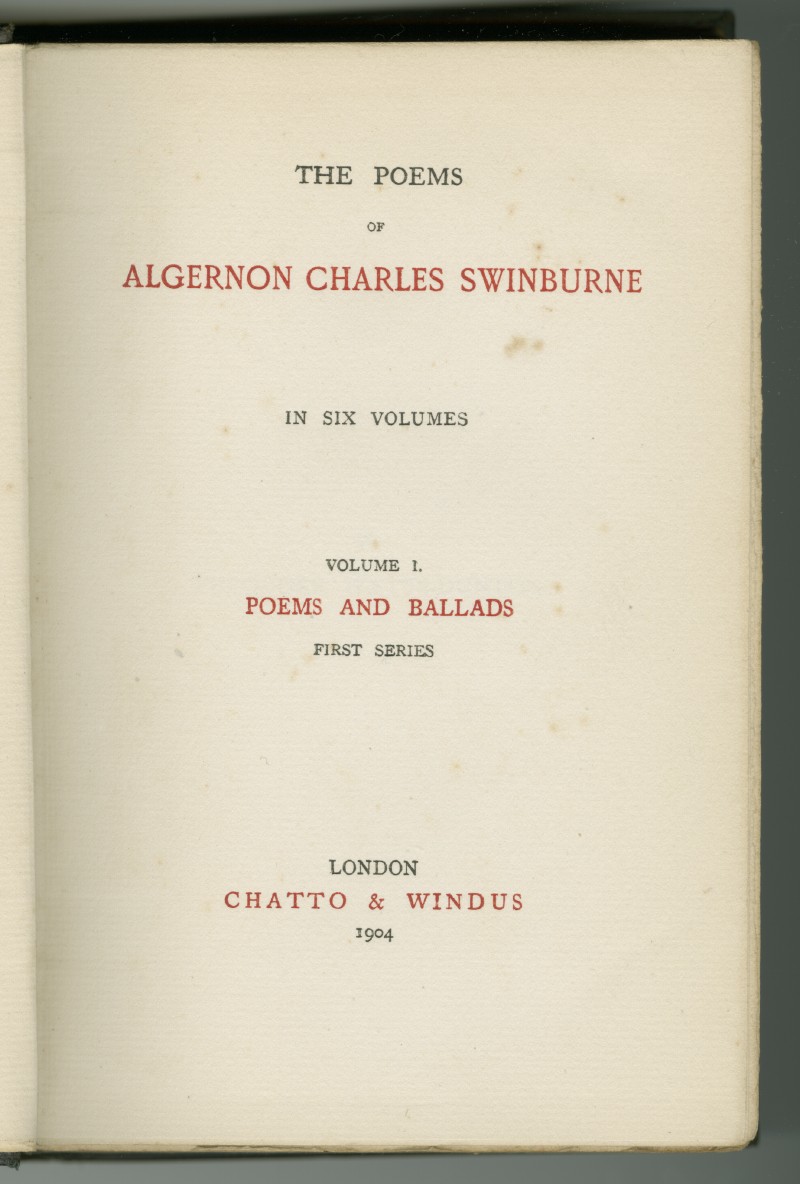 Elements for the encoding of
the information on a titlepage are presented in Title Pages; here we consider how we might go about encoding
some of the visual information as well, using the rendition
element and its corresponding attributes.
First we define a rendition element for each aspect of the source page rendition that we wish to retain. Details of CSS are given in CSS21; we use it here simply to provide a vocabulary with which to describe such aspects as font size and style, letter and line spacing, colour, etc. Note that the purpose of this encoding is to describe the original, rather than specify how it should be reproduced, although the two are obviously closely linked.
<styleDefDecl scheme="css" schemeVersion="2.1"/>
<!-- ... -->
<tagsDecl>
  <rendition xml:id="center">text-align: center;</rendition>
  <rendition xml:id="small">font-size: small;</rendition>
  <rendition xml:id="large">font-size: large;</rendition>
  <rendition xml:id="x-large">font-size: x-large;</rendition>
  <rendition xml:id="xx-large">font-size: xx-large</rendition>
  <rendition xml:id="expanded">letter-spacing: +3pt;</rendition>
  <rendition xml:id="x-space">line-height: 150%;</rendition>
  <rendition xml:id="xx-space">line-height: 200%;</rendition>
  <rendition xml:id="red">color: red;</rendition>
</tagsDecl>
The global @rendition attribute can now be used to specify on any element which of the above rendition features apply to it. For example, a title page might be encoded as follows:
<titlePage>
<docTitle rendition="#center #x-space">
<titlePart>
<lb/>
<hi rendition="#x-large">THE POEMS</hi>
<lb/>
<hi rendition="#small">OF</hi>
<lb/>
<hi rendition="#red #xx-large">ALGERNON CHARLES SWINBURNE</hi>
<lb/>
<hi rendition="#large #xx-space">IN SIX VOLUMES</hi>
</titlePart>
<titlePart rendition="#xx-space">
<lb/> VOLUME I.
<lb/>
<hi rendition="#red #x-large">POEMS AND BALLADS</hi>
<lb/>
<hi rendition="#x-space">FIRST SERIES</hi>
</titlePart>
</docTitle>
<docImprint rendition="#center">
<lb/>
<pubPlace rendition="#xx-space">LONDON</pubPlace>
<lb/>
<publisher rendition="#red #expanded">CHATTO & WINDUS</publisher>
<lb/>
<docDate when="1904" rendition="#small">1904</docDate>
</docImprint>
</titlePage>
When CSS is used as the style definition language, the @scope attribute may be used to specify CSS pseudo-elements. These pseudo-elements are used to specify styling applicable to only a portion of the given text. For example, the first-letter pseudo-element defines styling to be applied to the first letter in the targeted element, while the before and after pseudo-elements can be used often in conjunction with the "content" property to add additional characters which need to be added before or after the element content to make it more closely resemble the appearance of the source.
For example, assuming that a text has been encoded using the q element to enclose passages in quotation marks, but the quotation marks themselves have been routinely omitted from the encoding, a set of renditions such as the following:
<rendition xml:id="quoteBefore" scheme="css" scope="before">content:
'“';</rendition>
<rendition xml:id="quoteAfter" scheme="css" scope="after">content:
'”';</rendition>
<q rendition="#quoteBefore #quoteAfter">Four score and seven years
ago...</q>
2.3.4.2 Tag Usage
As noted above, each namespace element, if present, should contain up to one occurrence of a tagUsage element for each element type from the given namespace that occurs within the outermost text element associated with the teiHeader in which it appears.3 The tagUsage element may be used to supply a count of the number of occurrences of this element within the text, which is given as the value of its @occurs attribute. It may also be used to hold any additional usage information, which is supplied as running prose within the element itself.
For example:
<tagUsage gi="hi" occurs="28">
Used only to mark English words italicised in the copy text.</tagUsage>
The @withId attribute may optionally be used to specify how many of the occurrences of the element in question bear a value for the global @xml:id attribute, as in the following example:
<tagUsage gi="pb" occurs="321" withId="321"> Marks page beginnings in the York
(1734) edition only</tagUsage>
The content of the tagUsage element is not susceptible of automatic processing. It should not therefore be used to hold information for which provision is already made by other components of the encoding description. A TEI-conformant document is not required to provide any tagUsage elements or @occurs attributes, but if it does, then the counts provided must correspond with the number of such elements present in the associated text.
2.3.5 The Default Style Definition Language Declaration
The content of the rendition element, the value of its @selector attribute, and the value of the @style attribute are expressed using one of a small number of formally defined style definition languages. For ease of processing, it is strongly recommended to use a single such language throughout an encoding project, although the TEI system permits a mixture.
The element styleDefDecl, a sibling of the tagsDecl element, is used to supply the name of the default style definition language. The name is supplied as the value of the @scheme attribute and may take any of the following values:
- free
- Informal free text description
- css
- Cascading Stylesheet Language
- xslfo
- Extensible Stylesheet Language Formatting Objects
- other
- A user-defined formal description language
When the @style attribute is used, its value must always be expressed using whichever default style definition language is in force. If more than one occurrence of the styleDefDecl is provided, there will be more than one default available, and the @decls attribute must be used to select which is applicable in a given context, as discussed in section Associating Contextual Information with a Text.
2.3.6 The Reference System Declaration
The refsDecl element is used to document the way in which any standard referencing scheme built into the encoding works.
- refsDecl (references declaration) specifies how canonical references are constructed for this text.
- citeStructure (citation structure) declares a structure and method for citing the current document.
- cRefPattern (canonical reference pattern) specifies an expression and replacement pattern for transforming a canonical reference into a URI.
- refState (reference state) specifies one component of a canonical reference defined by the milestone method.
- att.patternReplacement provides attributes for regular-expression matching and replacement.
- att.citeStructurePart provides attributes for selecting particular elements within a document.
A referencing scheme may be described in one of four ways using this element:
- as a prose description
- as nested set of citation structure declarations
- as a series of pairs of regular expressions and XPaths
- as a concatenation of sequentially organized milestones
More than one refsDecl element can be included in the header if more than one canonical reference scheme is to be used in the same document, but the current proposals do not check for mutual inconsistency.
2.3.6.1 Prose Method
The referencing scheme may be specified within the refsDecl by a simple prose description. Such a description should indicate which elements carry identifying information, and whether this information is represented as attribute values or as content. Any special rules about how the information is to be interpreted when reading or generating a reference string should also be specified here. Such a prose description cannot be processed automatically, and this method of specifying the structure of a canonical reference system is therefore not recommended for automatic processing.
For example:
<refsDecl>
  <p>The <att>n</att> attribute of each text in this corpus carries a
unique identifying code for the whole text. The title of the text is
held as the content of the first<gi>head</gi> element within each
text. The<att>n</att> attribute on each <gi>div1</gi> and
    <gi>div2</gi> contains the canonical reference for each such
division, in the form 'XX.yyy', where XX is the book number in Roman
numerals, and yyy the section number in arabic. Line beginnings are
marked by empty<gi>lb</gi> elements, each of which includes the
through line number in Casaubon's edition as the value of its<gi>n</gi> attribute.</p>
  <p>The through line number and the text identifier uniquely identify
any line. A canonical reference may be made up by concatenating the<gi>n</gi> values from the <gi>text</gi>, <gi>div1</gi>, or
    <gi>div2</gi> and calculating the line number within each part.</p>
</refsDecl>
2.3.6.2 Search-and-Replace Method
This method often requires a significant investment of effort initially, but permits extremely flexible addressing. For details, see section Canonical References.
- cRefPattern (canonical reference pattern) specifies an expression and replacement pattern for transforming a canonical reference into a URI.
2.3.6.3 Milestone Method
This method is appropriate when only milestone tags (see section Milestone Elements) are available to provide the required referencing information. It does not provide any abilities which cannot be mimicked by the search-and-replace referencing method discussed in the previous section, but in the cases where it applies, it provides a somewhat simpler notation.
A reference based on milestone tags concatenates the values specified by one or more such tags. Since each tag marks the point at which a value changes, it may be regarded as specifying the refState of a variable. A reference declaration using this method therefore specifies the individual components of the canonical reference as a sequence of refState elements:
- refState (reference state) specifies one component of a canonical reference defined by the milestone method.
- att.milestoneUnit provides attributes to indicate the type of section which is changing at a specific milestone.
For example, the reference Matthew 12:34 might be thought of as representing the state of three variables: the book variable is in state Matthew; the chapter variable is in state 12, and the verse variable is in state 34. If milestone tagging has been used, there should be a tag marking the point in the text at which each of the above variables changes its state.4 To find Matthew 12:34 therefore an application must scan left to right through the text, monitoring changes in the state of each of these three variables as it does so. When all three are simultaneously in the required state, the desired point will have been reached. There may of course be several such points.
The @delim and @length attributes are used to specify components of a canonical reference using this method in exactly the same way as for the stepwise method described in the preceding section. The other attributes are used to determine which instances of milestone tags in the text are to be checked for state-changes. A state-change is signalled whenever a new milestone tag is found with @unit and, optionally, @ed attributes identical to those of the refState element in question. The value for the new state may be given explicitly by the @n attribute on the milestone element, or it may be implied, if the @n attribute is not specified.
For example, for canonical references in the form xx.yyy where the xx represents the page number in the first edition, and yyy the line number within this page, a reference system declaration such as the following would be appropriate:
<refsDecl>
  <refState ed="first" unit="page" length="2" delim="."/>
  <refState ed="first" unit="line" length="3"/>
</refsDecl>
<milestone n="II" ed="first" unit="page"/>
<milestone ed="first" unit="line"/>
The milestone referencing scheme, though conceptually simple, is not supported by a generic XML parser. Its use places a correspondingly greater burden of verification and accuracy on the encoder.
A reference system declaration which applies to more than one text or division of a text need not be repeated in the header of each such text. Instead, the @decls attribute of each text (or subdivision of the text) to which the declaration applies may be used to supply a cross-reference to it, as further described in section Associating Contextual Information with a Text.
2.3.7 The Classification Declaration
The classDecl element is used to group together definitions or sources for any descriptive classification schemes used by other parts of the header or elsewhere in the document. Each such scheme is represented by a taxonomy element, which may contain either a simple bibliographic citation, or a definition of the descriptive typology concerned; the following elements are used in defining a descriptive classification scheme:
- classDecl (classification declarations) contains one or more taxonomies defining any classificatory codes used elsewhere in the text.
- taxonomy (taxonomy) defines a typology either implicitly, by means of a bibliographic citation, or explicitly by a structured taxonomy.
- category (category) contains an individual descriptive category, possibly nested within a superordinate category, within a user-defined taxonomy.
- catDesc (category description) describes some category within a taxonomy or text typology, either in the form of a brief prose description or in terms of the situational parameters used by the TEI formal textDesc.
<taxonomy xml:id="DDC12">
  <bibl>
    <title>Dewey Decimal Classification</title>
    <edition>Abridged Edition 12</edition>
  </bibl>
</taxonomy>
If the category is subdivided, each subdivision is represented by a nested category element, having the same structure. Categories may be nested to an arbitrary depth in order to reflect the hierarchical structure of the taxonomy. Each category element bears a unique @xml:id attribute, which is used as the target for catRef elements referring to it.
<taxonomy xml:id="b">
  <bibl>Brown Corpus</bibl>
  <category xml:id="b.a">
    <catDesc>Press Reportage</catDesc>
    <category xml:id="b.a1">
      <catDesc>Daily</catDesc>
    </category>
    <category xml:id="b.a2">
      <catDesc>Sunday</catDesc>
    </category>
    <category xml:id="b.a3">
      <catDesc>National</catDesc>
    </category>
    <category xml:id="b.a4">
      <catDesc>Provincial</catDesc>
    </category>
    <category xml:id="b.a5">
      <catDesc>Political</catDesc>
    </category>
    <category xml:id="b.a6">
      <catDesc>Sports</catDesc>
    </category>
  </category>
  <category xml:id="b.d">
    <catDesc>Religion</catDesc>
    <category xml:id="b.d1">
      <catDesc>Books</catDesc>
    </category>
    <category xml:id="b.d2">
      <catDesc>Periodicals and tracts</catDesc>
    </category>
  </category>
</taxonomy>
Linkage between a particular text and a category within such a taxonomy is made by means of the catRef element within the textClass element, as described in section The Text Classification. Where finer-grained analysis is desired, the @ana attribute on an element in the text could point to a category, as in the following abbreviated example:
<taxonomy>
<category xml:id="poe">
<catDesc>Poetry</catDesc>
<category xml:id="sonn">
<catDesc>Sonnet</catDesc>
<category xml:id="shakesSonn">
<catDesc>Shakespearean Sonnet</catDesc>
</category>
<category xml:id="petraSonn">
<catDesc>Petrarchan Sonnet</catDesc>
</category>
</category>
<category xml:id="met">
<catDesc>Metrical Categories</catDesc>
<category xml:id="ft">
<catDesc>Metrical Feet</catDesc>
<category xml:id="iamb">
<catDesc>Iambic</catDesc>
</category>
<category xml:id="troch">
<catDesc>trochaic</catDesc>
</category>
</category>
<category xml:id="ftNm">
<catDesc>Number of feet</catDesc>
<category xml:id="penta">
<catDesc>>Pentameter</catDesc>
</category>
<category xml:id="tetra">
<catDesc>>Tetrameter</catDesc>
</category>
</category>
</category>
</category>
</taxonomy>
<!-- elsewhere in document -->
<lg ana="#shakesSonnet #iamb #penta">
<l>Shall I compare thee to a summer's day</l>
<!-- ... -->
</lg>
Where the taxonomy permits of classification along more than one dimension, more than one category will be referenced by a particular catRef, as in the following example, which identifies a text with the sub-categories Daily, National, and Political within the category Press Reportage as defined above.
<catRef target="#b.a1 #b.a3 #b.a5"/>
A single category may contain more than one catDesc child, when for example the category is described in more than one language, as in the following example:
<category xml:id="lit">
  <catDesc xml:lang="pl">literatura piękna</catDesc>
  <catDesc xml:lang="en">fiction</catDesc>
  <category xml:id="litProza">
    <catDesc xml:lang="pl">proza</catDesc>
    <catDesc xml:lang="en">prose</catDesc>
  </category>
  <category xml:id="litPoezja">
    <catDesc xml:lang="pl">poezja</catDesc>
    <catDesc xml:lang="en">poetry</catDesc>
  </category>
  <category xml:id="litDramat">
    <catDesc xml:lang="pl">dramat</catDesc>
    <catDesc xml:lang="en">drama</catDesc>
  </category>
</category>
2.3.8 The Geographic Coordinates Declaration
The following element is provided to indicate (within the header of a document, or in an external location) that a particular coordinate notation, or a particular datum, has been employed in a text. The default notation is a string containing two real numbers separated by whitespace, of which the first indicates latitude and the second longitude according to the 1984 World Geodetic System (WGS84).
2.3.9 The Unit Declaration
When documents feature units of measurement that are not listed in the International System of Units, the unitDecl element may be used in the encoding description to provide definitions and information about their origins and equivalents.
- unitDecl (unit declarations) provides information about units of measurement that are not members of the International System of Units.
The unitDecl contains one or more unitDef child elements that serve to describe units of measure which may be marked in unit elements within the text.
- unitDef (unit definition) contains descriptive information related to a specific unit of measurement.
- unit contains a symbol, a word or a phrase referring to a unit of measurement in any kind of formal or informal system.
- conversion defines how to calculate one unit of measure in terms of another.
- att.formula provides attributes for defining a mathematical formula.
- att.locatable provides attributes for referencing locations by pointing to entries in a canonical list of places.
<encodingDesc>
  <unitDecl>
    <unitDef xml:id="keel" type="weight">
      <label>keel</label>
      <placeName ref="#england"/>
      <conversion fromUnit="#chalder" toUnit="#keel" formula="$fromUnit * 20" from="1421" to="1676"/>
      <conversion fromUnit="#chalder" toUnit="#keel" formula="$fromUnit * 16" from="1676" to="1824"/>
      <desc>Keel was a unit measuring weight of coal. It had been equal to 20 chalders from 1421 to 1676, and it was made to be equivalent to 16 chalders from 1676 to 1824.</desc>
    </unitDef>
    <unitDef xml:id="chalder" type="weight">
      <label>chalder</label>
      <placeName ref="#england"/>
      <conversion fromUnit="#bushel" toUnit="#chalder" formula="$fromUnit * 32" from="1421" to="1676"/>
      <conversion fromUnit="#bushel" toUnit="#chalder" formula="$fromUnit * 36" from="1676" to="1824"/>
      <desc>Chalder was a unit measuring weight of coal. It had been equal to 32 bushels from 1421 to 1676, and it was made to be equivalent to 36 bushels from 1676 to 1824.</desc>
    </unitDef>
    <unitDef xml:id="bushel" type="weight">
      <label>bushel</label>
      <placeName ref="#england"/>
      <desc>Bushel was a unit measuring weight of coal.</desc>
    </unitDef>
  </unitDecl>
</encodingDesc>
<encodingDesc>
  <unitDecl>
    <unitDef xml:id="Celsius" type="temperature">
      <label>Celsius or Centigrade scale</label>
      <conversion fromUnit="#Fahrenheit" toUnit="#Celsius" formula="($fromUnit - 32) * (5 div 9)"/>
      <desc>To convert from the Fahrenheit to the Celsius scale, subtract 32 from the Celsius temperature and multiply by 5/9.</desc>
    </unitDef>
  </unitDecl>
</encodingDesc>
<unitDef type="volume" xml:id="shunbul">
  <label xml:lang="ar-Latn-x-ijmes">shunbul</label>
  <label xml:lang="ar">شنبل</label>
  <conversion formula="$fromUnit * 2.5" fromUnit="#shunbul" toUnit="#kile" when="1873" where="#acre #tripoli"/>
  <conversion formula="$fromUnit * 2.25" fromUnit="#shunbul" toUnit="#kile" when="1878" where="#acre #tripoli"/>
  <conversion formula="$fromUnit * 3" from="1891" fromUnit="#shunbul" to="1910" toUnit="#kile" where="#aleppo"/>
  <conversion formula="$fromUnit * 2.5" fromUnit="#shunbul" toUnit="#kile_istanbul" when="1860" where="#aleppo"/>
  <conversion formula="$fromUnit * 72" fromUnit="#shunbul" toUnit="#madd" when="1893" where="#damascus"/>
  <desc xml:lang="en">The <foreign xml:lang="ar-Latn-x-ijmes">shunbul</foreign> was the main unit to measure grain in the Northern parts of Greater Syria.</desc>
</unitDef>
2.3.10 The Schema Specification
The schemaSpec element contains a schema specification. When this element appears inside encodingDesc, it allows embedding of a TEI ODD customization file inside a TEI header; alternatively, this element may be used in the body of an ODD document. The use of ODD files, and their relationship to schemas, is described in detail in Documentation Elements.
A schemaSpec element contains all the information needed to generate schemas for a particular TEI customization, and the ODD documentation elements, by reference to the TEI, are more succinct than the schemas derived from them. Therefore you may find it convenient to make a copy of the schemaSpec from your project's ODD document inside the teiHeader itself, in addition to supplying an external schema and/or ODD file; if the XML file becomes separated from its schema, the schema can be regenerated at any time using the information in the schemaSpec element. For example:
<encodingDesc>
  <!-- Other encoding description elements... -->
  <schemaSpec ident="myTEICustomization" docLang="en" prefix="tei_" xml:lang="en" source="#NONE">
    <moduleRef key="core"/>
    <moduleRef key="tei"/>
    <moduleRef key="header"/>
    <moduleRef key="textstructure"/>
  </schemaSpec>
</encodingDesc>
Alternatively, it is possible to point to an external ODD customization file or schema through use of the schemaRef element. More than one schemaRef element may be provided for different sources, stages in a workflow, or formats.
<schemaRef type="interchangeODD" url="http://www.tei-c.org/release/xml/tei/custom/odd/tei_lite.odd"/>
<schemaRef type="interchangeRNG" url="http://www.tei-c.org/release/xml/tei/custom/odd/tei_lite.rng"/>
<schemaRef type="projectODD" url="file:///schema/project.odd"/>
2.3.11 The Application Information Element
It is sometimes convenient to store information relating to the processing of an encoded resource within its header. Typical uses for such information might be:
- to allow an application to discover that it has previously opened or edited a file, and what version of itself was used to do that;
- to show (through a date) which application last edited the file to allow for diagnosis of any problems that might have been caused by that application;
- to allow users to discover information about an application used to edit the file;
- to allow the application to declare an interest in elements of the file which it has edited, so that other applications or human editors may be more wary of making changes to those sections of the file.
The class model.applicationLike provides an element, application, which may be used to record such information within the appInfo element.
- appInfo (application information) records information about an application which has edited the TEI file.
- application provides information about an application which has acted upon the document.
Each application element identifies the current state of one software application with regard to the current file. This element is a member of the att.datable class, which provides a variety of attributes for associating this state with a date and time, or a temporal range. The @ident and @version attributes should be used to uniquely identify the application and its major version number (for example, ImageMarkupTool 1.5). It is not intended that an application should add a new application each time it touches the file.
The following example shows how these elements might be used to document the fact that version 1.5 of an application called Image Markup Tool has an interest in two parts of a document which was last saved on 06 June 2006. The parts concerned are accessible at the URLs given as the @target attributes of the two ptr elements.
<appInfo>
  <application version="1.5" ident="ImageMarkupTool" notAfter="2006-06-01">
    <label>Image Markup Tool</label>
    <ptr target="#P1"/>
    <ptr target="#P2"/>
  </application>
</appInfo>
2.3.12 Module-Specific Declarations
The elements discussed so far are available to any schema. When the schema in use includes some of the more specialized TEI modules, these make available other more module-specific components of the encoding description. These are discussed fully in the documentation for the module in question, but are also noted briefly here for convenience.
The fsdDecl element is available only when the iso-fs module is included in a schema. Its purpose is to document the feature system declaration (as defined in chapter Feature System Declaration) underlying any analytic feature structures (as defined in chapter Feature Structures) present in the text documented by this header.
The metDecl element is available only when the verse module is included in a schema. Its purpose is to document any metrical notation scheme used in the text, as further discussed in section Rhyme and Metrical Analysis. It consists either of a prose description or a series of metSym elements.
The variantEncoding element is available only when the textcrit module is included in a schema. Its purpose is to document the method used to encode textual variants in the text, as discussed in section Linking the Apparatus to the Text.
2.4 The Profile Description
The profileDesc element is the third major subdivision of the TEI header. It is an optional element, the purpose of which is to enable information characterizing various descriptive aspects of a text or a corpus to be recorded within a single unified framework.
- profileDesc (text-profile description) provides a detailed description of non-bibliographic aspects of a text, specifically the languages and sublanguages used, the situation in which it was produced, the participants and their setting.
The profileDesc element contains elements taken from the model.profileDescPart class. The default members of this class are the following :
- abstract contains a summary or formal abstract prefixed to an existing source document by the encoder.
- creation (creation) contains information about the creation of a text.
- langUsage (language usage) describes the languages, sublanguages, registers, dialects, etc. represented within a text.
- textClass (text classification) groups information which describes the nature or topic of a text in terms of a standard classification scheme, thesaurus, etc.
- correspDesc (correspondence description) contains a description of the actions related to one act of correspondence.
- calendarDesc (calendar description) contains a description of the calendar system used in any dating expression found in the text.
When the corpus module described in chapter Language Corpora is included in a schema, three further elements become available within the profileDesc element:
- textDesc (text description) provides a description of a text in terms of its situational parameters.
- particDesc (participation description) describes the identifiable speakers, voices, or other participants in any kind of text or other persons named or otherwise referred to in a text, edition, or metadata.
- settingDesc (setting description) describes the setting or settings within which a language interaction takes place, or other places otherwise referred to in a text, edition, or metadata.
When the transcr module for the transcription of primary sources described in chapter Representation of Primary Sources is included in a schema, the following elements become available within the profileDesc element:
- handNotes contains one or more handNote elements documenting the different hands identified within the source texts.
- listTranspose supplies a list of transpositions, each of which is indicated at some point in a document typically by means of metamarks.
The listTranspose element is discussed in detail in section Transpositions.
2.4.1 Creation
The creation element contains phrases describing the origin of the text, e.g. the date and place of its composition.
- creation (creation) contains information about the creation of a text.
<creation>
  <date when="1992-08">August 1992</date>
  <rs type="city">Taos, New Mexico</rs>
</creation>
2.4.2 Language Usage
The langUsage element is used within the profileDesc element to describe the languages, sublanguages, registers, dialects, etc. represented within a text. It contains one or more language elements, each of which provides information about a single language, notably the quantity of that language present in the text. Note that this element should not be used to supply information about any non-standard characters or glyphs used by this language; such information should be recorded in the charDecl element in the encoding description (see further Characters, Glyphs, and Writing Modes).
- langUsage (language usage) describes the languages, sublanguages, registers, dialects, etc. represented within a text.
- language (language) characterizes a single language or sublanguage used within a text.
A language element may be supplied for each different language used in a document. If used, its @ident attribute should specify an appropriate language identifier, as further discussed in section Language Identification. This is particularly important if extended language identifiers have been used as the value of @xml:lang attributes elsewhere in the document.
Here is an example of the use of this element:
<langUsage>
  <language ident="fr-CA" usage="60">Québecois</language>
  <language ident="en-CA" usage="20">Canadian business English</language>
  <language ident="en-GB" usage="20">British English</language>
</langUsage>
2.4.3 The Text Classification
The textClass element is used to classify a text in some way.
- textClass (text classification) groups information which describes the nature or topic of a text in terms of a standard classification scheme, thesaurus, etc.
Text classification may be carried out according to one or more of the following methods:
- by reference to a recognized international classification such as the Dewey Decimal Classification, the Universal Decimal Classification, the Colon Classification, the Library of Congress Classification, or any other system widely used in library and documentation work
- by providing a set of keywords, as provided for example by British Library or Library of Congress Cataloguing in Publication data
- by referencing any other taxonomy of text categories recognized in the field concerned, or peculiar to the material in hand; this may include one based on recurring sets of values for the situational parameters defined in section The Text Description, or the demographic elements described in section The Participant Description
The following elements are provided for this purpose:
- keywords (keywords) contains a list of keywords or phrases identifying the topic or nature of a text.
- classCode (classification code) contains the classification code used for this text in some standard classification system.
- catRef (category reference) specifies one or more defined categories within some taxonomy or text typology.
The keywords element simply categorizes an individual text by supplying a list of keywords which may describe its topic or subject matter, its form, date, etc. In some schemes, the order of items in the list is significant, for example, from major topic to minor; in others, the list has an organized substructure of its own. No recommendations are made here as to which method is to be preferred. Wherever possible, such keywords should be taken from a recognized source, such as the British Library/Library of Congress Cataloguing in Publication data in the case of printed books, or a published thesaurus appropriate to the field.
The @scheme attribute is used to indicate the source of the keywords used, in the case where such a source exists. If the keywords are taken from an externally defined authority which is available online, this attribute should point directly to it, as in the following examples:
<keywords scheme="http://classificationweb.net">
  <term>Babbage, Charles</term>
  <term>Mathematicians - Great Britain - Biography</term>
</keywords>
<keywords scheme="http://id.loc.gov/authorities/about.html#lcsh">
  <term>English literature -- History and criticism -- Data processing.</term>
  <term>English literature -- History and criticism -- Theory, etc.</term>
  <term>English language -- Style -- Data processing.</term>
  <term>Style, Literary -- Data processing.</term>
</keywords>
If the authority file is not available online, but is generally recognized and commonly cited, a bibliographic description for it should be supplied within the taxonomy element described in section The Classification Declaration; the @scheme attribute may then reference that taxonomy element by means of its identifier in the usual way:
<keywords scheme="#welch">
  <term>ceremonials</term>
  <term>fairs</term>
  <term>street life</term>
</keywords>
<!-- elsewhere in the document -->
<taxonomy xml:id="welch">
  <bibl>
    <title>Notes on London Municipal Literature, and a Suggested
Scheme for Its Classification</title>
    <author>Charles Welch</author>
    <edition>1895</edition>
  </bibl>
</taxonomy>
If no authority file exists, perhaps because the keywords used were assigned directly by an author, the @scheme attribute should be omitted.
Alternatively, if the keyword vocabulary itself is locally defined, the @scheme attribute will point to the local definition, which will typically be held in a taxonomy element within the classDecl part of the encoding description (see section The Classification Declaration).
The classCode element also categorizes an individual text, by supplying a numerical or other code rather than descriptive terms. Such codes constitute a recognized classification scheme, such as the Dewey Decimal Classification. On this element, the @scheme attribute is required; it indicates the source of the classification scheme in the same way as for keywords: this may be a pointer of any kind, either to a TEI element, possibly in the current document, as in the keywords examples above, or to some canonical source for the scheme, as in the following example:
<classCode scheme="http://www.udcc.org/udcsummary/php/index.php">005.756</classCode>
The catRef element categorizes an individual text by pointing to one or more category elements using the @target attribute, which it inherits from the att.pointing class. The category element (which is fully described in section The Classification Declaration) holds information about a particular classification or category within a given taxonomy. Each such category must have a unique identifier, which may be supplied as the value of the @target attribute for catRef elements which are regarded as falling within the category indicated.
A text may, of course, fall into more than one category, in which case more than one identifier may be supplied as the value for the @target attribute on the catRef element, as in the following example:
<catRef target="#b.a4 #b.d2"/>
The @scheme attribute may be supplied to specify the taxonomy to which the categories identified by the target attribute belong, if this is not adequately conveyed by the resource pointed to. For example,
<catRef target="#b.a4 #b.d2" scheme="http://www.example.com/browncorpus"/>
<catRef target="http://www.example.com/SUC/#A45"/>
In general, it is a matter of style whether to use a single catRef with multiple identifiers in the value of @target or multiple catRef elements, each with a single identifier in the value of @target. However, note that maintenance of a TEI document with a large number of values within a single @target can be cumbersome.
The distinction between the catRef and classCode elements is that the values used as identifying codes are exhaustively enumerated for the former, typically within the TEI header. In the latter case, however, the values use any externally-defined scheme, and therefore may be taken from a more open-ended descriptive classification system.
2.4.4 Abstracts
The main purpose of the abstract element is to supply a brief resume or abstract for an article which was originally published without such a component. An abstract or summary forming part of the document at its creation should usually appear in the front matter (front) of the document.
<profileDesc>
  <abstract>
    <p>This paper is a draft studying
various aspects of using the TEI
as a reference serialization framework
for LMF. Comments are welcome to bring
this to a useful document for the
community.</p>
  </abstract>
</profileDesc>
Abstracts may be provided in multiple languages, distinguished by the @xml:lang attribute:
<profileDesc>
  <abstract xml:lang="en">
    <p>The recent archaeological emphasis
on the study of settlement patterns,
landscape and palaeoenvironments has
shaped and re-shaped our understanding
of the Viking settlement of Iceland.
This paper reviews the developments
in Icelandic archaeology, examining
both theoretical and practical advances.
Particular attention is paid to new
ideas in terms of settlement patterns
and resource exploitation. Finally,
some of the key studies of the ecological
consequences of the Norse<foreign xml:lang="is">landnám</foreign>
are presented.</p>
  </abstract>
  <abstract xml:lang="fr">
    <p>L’accent récent des
recherches archéologiques sur l’étude des
configurations spatiales des colonies, de la
géographie des sites ainsi que des éléments
paléo-environnementaux nous mène à réexaminer
et réévaluer nos connaissances acquises sur
la colonisation de l’Islande par les Vikings.
Cet article passe en revue le développement
de l’archéologie islandaise en examinant les
progrès théoriques et pratiques en la matière.
Une attention particulière est portée sur
l’étude des configurations spatiales des
colonies ainsi qu’une considération des
questions d’exploitation des ressources.
Finalement, l’article présente un aperçu des
études principales qui traitent des
conséquences écologiques du<foreign xml:lang="is">landnám</foreign>
islandais.</p>
  </abstract>
</profileDesc>
The same element may be used to provide other summary information supplied by the encoder, perhaps grouped together into a list of discrete items:
<profileDesc>
  <abstract>
    <list>
      <item>An annual HBC supply ship is
set to the North West Coast for mid-September.</item>
      <item>
        <name key="pelly_jh">Pelly</name> writes
to ascertain the British Government's plans
for the lands associated with the Oregon Treaty;
he wants to know what will happen to the HBC's
establishment on the southern<name type="place" key="vancouver_island">Vancouver Island</name>.
He adds that a former Crown grant, an 1838 exclusive
trade-grant for the lands in question, has yet to
expire.</item>
      <item>The minutes discuss the nature of the HBC's
original entitlements and question whether or not,
and in what capacity, the Oregon Treaty affects the
HBC's position. The majority council further
investigation, and to reply cautiously and
judiciously to the HBC inquiry.</item>
      <item>A
summary of a meeting with<name key="pelly_jh">Pelly</name> is offered in
order to elucidate the HBC's intentions.</item>
      <item>
        <name key="grey_hg">Lord Grey</name> calls
for greater consideration on the issue of
colonization; he asks that<name key="stephen_j">Stephen</name> write the Company,
asking them to detail their intentions, and to
state their legal opinion for entitlement.</item>
    </list>
  </abstract>
</profileDesc>
2.4.5 Calendar Description
The calendarDesc element is used within the profileDesc element to document objects referenced by means of either the @calendar attribute on date or the @datingMethod attribute on any member of the att.datable class.
- calendarDesc (calendar description) contains a description of the calendar system used in any dating expression found in the text.
This element may contain one or more calendar elements:
- calendar (calendar) describes a calendar or dating system used in a dating formula in the text.
Each such element contains one or more paragraphs of description for the calendar system concerned, and also supplies an identifying code for it as the value of its @xml:id attribute. A calendar element may also have a @type (and @subtype) attribute in order to categorize the calendar in any convenient way. In the following example, @type is used to differentiate real calendar systems in actual use from those used in a fictional environment.
<calendarDesc>
  <calendar xml:id="Gregorian" type="actual">
    <p>Gregorian calendar</p>
  </calendar>
  <calendar xml:id="Stardate" type="fictional">
    <p>Fictional Stardate (from Star Trek series)</p>
  </calendar>
  <calendar xml:id="BP" type="actual">
    <p>Calendar years before present (measured from 1950)</p>
  </calendar>
</calendarDesc>
This identifying code may then be referenced from any element supplying a date expressed using that calendar system:
<p>Captain's log <date calendar="#stardate">stardate 23.9 rounded off
to the nearest decimal point</date>...</p>
2.4.6 Correspondence Description
The correspDesc element is used within the profileDesc element to provide detailed correspondence-specific metadata, concerning in particular the communicative aspects (sending, receiving, forwarding etc.) associated with an act of correspondence.
This information is complementary to the detailed descriptions of physical objects (such as letters) associated with correspondence acts, which are typically provided by the sourceDesc element.
- correspDesc (correspondence description) contains a description of the actions related to one act of correspondence.
The correspDesc element contains the elements correspAction and correspContext, describing the actions identified and the context in which the correspondence occurs respectively.
- correspAction (correspondence action) contains a structured description of the place, the name of a person/organization and the date related to the sending/receiving of a message or any other action related to the correspondence.
- correspContext (correspondence context) provides references to preceding or following correspondence related to this piece of correspondence.
Acts of correspondence typically do not occur in isolation from each other. The correspContext element is used to group references relevant to the item of correspondence being described, typically to other items such as the item to which it is a reply, or the item which replies to it:
<correspContext>
  <ref type="prev" target="#CLF0102">Previous letter of <persName>Chamisso</persName> to <persName>de La
Foye</persName>: <date when="1807-01-16">16 January 1807</date>
  </ref>
  <ref type="next" target="#CLF0104">Next letter of <persName>Chamisso</persName> to <persName>de La Foye</persName>:
    <date when="1810-05-07">07 May 1810</date>
  </ref>
</correspContext>
Many types of correspondence actions may be distinguished. The @type attribute should be used to indicate the type of action being documented, using values such as those suggested above.
The following simple example uses correspAction to describe the sending of a letter by Adelbert von Chamisso from Vertus on 29 January 1807 to Louis de La Foye at Caen. The date of reception is unknown:
<correspAction type="sent">
  <persName>Adelbert von Chamisso</persName>
  <placeName>Vertus</placeName>
  <date when="1807-01-29"/>
</correspAction>
<correspAction type="received">
  <persName>Louis de La Foye</persName>
  <placeName>Caen</placeName>
  <date>unknown</date>
</correspAction>
Several senders, recipients, etc. can be specified for a single correspAction if the action is considered to apply to them all acting as a single group. In the following example, two people are considered to have received the piece of correspondence.
<correspAction type="received">
  <persName>Hermann Hesse</persName>
  <persName>Ninon Hesse</persName>
  <placeName>Montagnola</placeName>
</correspAction>
The @subtype attribute may be used to further distinguish types of action. In the following example, an e-mail is sent to two people directly and to a third by carbon copy (cc).
<correspAction type="sent">
  <persName>PN0001</persName>
  <date when="1999-06-02"/>
</correspAction>
<correspAction type="received" subtype="to">
  <persName>PN0002</persName>
</correspAction>
<correspAction type="received" subtype="to">
  <persName>PN0003</persName>
</correspAction>
<correspAction type="received" subtype="cc">
  <persName>PN0004</persName>
</correspAction>
The same person may be associated with several actions. For example, it will often be the case that the author and sender of a message are identical, and that many individual letters will need to be associated with the same person. The @sameAs attribute defined in section Identical Elements and Virtual Copies may be used to indicate that the same name applies to many actions. Its value will usually be the identifier of an element defining the person or name concerned, which is supplied elsewhere in the document.
<correspAction type="sent">
  <name sameAs="#author"/>
</correspAction>
It is assumed that each correspondence action applies to a single act of communication. However, it may be the case that the same physical object is involved in several such acts, if for example person A sends a letter to person B, who then annotates it and sends it on to person C, or if persons A and B both use the same document to convey quite different messages. In such situations, multiple correspDesc elements should be supplied, one for each communication. In the following example, the same document contains distinct messages, sent by two different people to the same destination: correspDesc is used for each separately:
<correspDesc xml:id="message1">
  <correspAction type="sent">
    <persName>John Gneisenau Neihardt</persName>
    <placeName>Branson (Montgomery)</placeName>
    <date when="1932-12-17"/>
  </correspAction>
  <correspAction type="received">
    <persName xml:id="JTH">Julius Temple House</persName>
    <placeName>New York</placeName>
  </correspAction>
</correspDesc>
<correspDesc xml:id="message2">
  <correspAction type="sent">
    <persName>Enid Neihardt</persName>
    <placeName>Branson (Montgomery)</placeName>
    <date when="1932-12-17"/>
  </correspAction>
  <correspAction type="received">
    <persName sameAs="#JTH"/>
    <placeName>New York</placeName>
  </correspAction>
</correspDesc>
2.5 Non-TEI Metadata
Projects often maintain metadata about their TEI documents in more than one form or system. For example, a project may have a database of bibliographic information on the set of documents they intend to encode. From this database, both a MARC record and a teiHeader are generated. The document is then encoded, during which process additional information is added to the teiHeader manually. Then, when the document is published on the web, a Dublin Core record is generated for discoverability of the resource. It is sometimes advantageous to store some or all of the non-TEI metadata in the TEI file.
Such non-TEI data may be placed anywhere within a TEI file (other than as the root element), as it does not affect TEI conformance. However, it is easier for humans to manage these kinds of data if they are grouped together in a single location. In addition, such grouping makes it easy to avoid accidentally flagging non-TEI data as errors during validation of the file against a TEI schema. The xenoData element, which may appear in the TEI header after the fileDesc but before the optional revisionDesc, is provided for this purpose. Where the use of xenoData is primarily to store linked data, contextual information, or stand-off annotations that refer to the contents of the TEI file itself, the xenoData element may be placed inside the standOff element instead.
- xenoData (non-TEI metadata) provides a container element into which metadata in non-TEI formats may be placed.
The xenoData element may contain anything except TEI elements. It may contain one or more elements from outside the TEI5 or data in some non-XML text format.6
In the following example, the prefix rdf is bound to the namespace http://www.w3.org/1999/02/22-rdf-syntax-ns#, the prefix dc is bound to the namespace http://purl.org/dc/elements/1.1/, and the prefix cc is bound to the namespace http://web.resource.org/cc/.
<xenoData>
  <rdf:RDF>
    <cc:Work rdf:about="">
      <dc:title>Applied Software Project Management  - review</dc:title>
      <dc:type rdf:resource="http://purl.org/dc/dcmitype/Text"/>
      <dc:license rdf:resource="http://creativecommons.org/licenses/by-sa/2.0/uk/"/>
    </cc:Work>
    <cc:License rdf:about="http://creativecommons.org/licenses/by-sa/2.0/uk/">
      <cc:permits rdf:resource="http://web.resource.org/cc/Reproduction"/>
      <cc:permits rdf:resource="http://web.resource.org/cc/Distribution"/>
      <cc:requires rdf:resource="http://web.resource.org/cc/Notice"/>
      <cc:requires rdf:resource="http://web.resource.org/cc/Attribution"/>
      <cc:permits rdf:resource="http://web.resource.org/cc/DerivativeWorks"/>
      <cc:requires rdf:resource="http://web.resource.org/cc/ShareAlike"/>
    </cc:License>
  </rdf:RDF>
</xenoData>
2.6 The Revision Description
The final sub-element of the TEI header, the revisionDesc element, provides a detailed change log in which each change made to a text may be recorded. Its use is optional but highly recommended. It provides essential information for the administration of large numbers of files which are being updated, corrected, or otherwise modified as well as extremely useful documentation for files being passed from researcher to researcher or system to system. Without change logs, it is easy to confuse different versions of a file, or to remain unaware of small but important changes made in the file by some earlier link in the chain of distribution. No significant change should be made in any TEI-conformant file without corresponding entries being made in the change log.
- revisionDesc (revision description) summarizes the revision history for a file.
- listChange groups a number of change descriptions associated with either the creation of a source text or the revision of an encoded text.
- change (change) documents a change or set of changes made during the production of a source document, or during the revision of an electronic file.
The main purpose of the revision description is to record changes in the text to which a header is prefixed. However, it is recommended TEI practice to include entries also for significant changes in the header itself (other than the revision description itself, of course). At the very least, an entry should be supplied indicating the date of creation of the header.
The log consists of a list of entries, one for each change. Changes may be grouped and organised using either the listChange element described in section Identifying Changes and Revisions or the simple list element described in section Lists. Alternatively, a simple sequence of change elements may be given. The attributes @when and @who may be supplied for each change element to indicate its date and the person responsible for it respectively. The description of the change itself can range from a simple phrase to a series of paragraphs. If a number is to be associated with one or more changes (for example, a revision number), the global @n attribute may be used to indicate it.
It is recommended to give changes in reverse chronological order, most recent first.
For example:
<!-- ... -->
<revisionDesc>
  <change n="RCS:1.39" when="2007-08-08" who="#jwernimo.lrv">Changed <val>drama.verse</val>
    <gi>lg</gi>s to <gi>p</gi>s. <note>we have opened a discussion about the need for a new
value for<att>type</att> of <gi>lg</gi>, <val>drama.free.verse</val>, in order to address
the verse of Behn which is not in regular iambic pentameter. For the time being these
instances are marked with a comment note until we are able to fully consider the best way
to encode these instances.</note>
  </change>
  <change n="RCS:1.33" when="2007-06-28" who="#pcaton.xzc">Added <att>key</att> and <att>reg</att>
to<gi>name</gi>s.</change>
  <change n="RCS:1.31" when="2006-12-04" who="#wgui.ner">Completed renovation. Validated.</change>
</revisionDesc>
<titleStmt>
  <title>The Amorous Prince, or, the Curious Husband, 1671</title>
  <author>
    <persName ref="#abehn.aeh">Behn, Aphra</persName>
  </author>
  <respStmt xml:id="pcaton.xzc">
    <persName>Caton, Paul</persName>
    <resp>electronic publication editor</resp>
  </respStmt>
  <respStmt xml:id="wgui.ner">
    <persName>Gui, Weihsin</persName>
    <resp>encoder</resp>
  </respStmt>
  <respStmt xml:id="jwernimo.lrv">
    <persName>Wernimont, Jacqueline</persName>
    <resp>encoder</resp>
  </respStmt>
</titleStmt>
2.7 Minimal and Recommended Headers
The TEI header allows for the provision of a very large amount of information concerning the text itself, its source, its encodings, and revisions of it, as well as a wealth of descriptive information such as the languages it uses and the situation(s) in which it was produced, together with the setting and identity of participants within it. This diversity and richness reflects the diversity of uses to which it is envisaged that electronic texts conforming to these Guidelines will be put. It is emphatically not intended that all of the elements described above should be present in every TEI header.
The amount of encoding in a header will depend both on the nature and the intended use of the text. At one extreme, an encoder may expect that the header will be needed only to provide a bibliographic identification of the text adequate to local needs. At the other, wishing to ensure that their texts can be used for the widest range of applications, encoders will want to document as explicitly as possible both bibliographic and descriptive information, in such a way that no prior or ancillary knowledge about the text is needed in order to process it. The header in such a case will be very full, approximating to the kind of documentation often supplied in the form of a manual. Most texts will lie somewhere between these extremes; textual corpora in particular will tend more to the latter extreme. In the remainder of this section we demonstrate first the minimal, and next a commonly recommended, level of encoding for the bibliographic information held by the TEI header.
Supplying only the minimal level of encoding required, the TEI header of a single text might look like the following example:
<teiHeader>
  <fileDesc>
    <titleStmt>
      <title>Thomas Paine: Common sense, a
machine-readable transcript</title>
      <respStmt>
        <resp>compiled by</resp>
        <name>Jon K Adams</name>
      </respStmt>
    </titleStmt>
    <publicationStmt>
      <distributor>Oxford Text Archive</distributor>
    </publicationStmt>
    <sourceDesc>
      <bibl>The complete writings of Thomas Paine, collected and edited
by Phillip S. Foner (New York, Citadel Press, 1945)</bibl>
    </sourceDesc>
  </fileDesc>
</teiHeader>
The only mandatory component of the TEI header is the fileDesc element. Within this, titleStmt, publicationStmt, and sourceDesc are all required constituents. Within the title statement, a title is required, and an author should be specified, even if it is unknown, as should some additional statement of responsibility, here given by the respStmt element. Within the publicationStmt, a publisher, distributor, or other agency responsible for the file must be specified. Finally, the source description should contain at the least a loosely structured bibliographic citation identifying the source of the electronic text if (as is usually the case) there is one.
We now present the same example header, expanded to include additionally recommended information, adequate to most bibliographic purposes, in particular to allow for the creation of an AACR2-conformant bibliographic record. We have also added information about the encoding principles used in this (imaginary) encoding, about the text itself (in the form of Library of Congress subject headings), and about the revision of the file.
<teiHeader>
  <fileDesc>
    <titleStmt>
      <title>Common sense, a machine-readable transcript</title>
      <author>Paine, Thomas (1737-1809)</author>
      <respStmt>
        <resp>compiled by</resp>
        <name>Jon K Adams</name>
      </respStmt>
    </titleStmt>
    <editionStmt>
      <edition>
        <date>1986</date>
      </edition>
    </editionStmt>
    <publicationStmt>
      <distributor>Oxford Text Archive.</distributor>
      <address>
        <addrLine>Oxford University Computing Services,</addrLine>
        <addrLine>13 Banbury Road,</addrLine>
        <addrLine>Oxford OX2 6RB,</addrLine>
        <addrLine>UK</addrLine>
      </address>
    </publicationStmt>
    <notesStmt>
      <note>Brief notes on the text are in a
supplementary file.</note>
    </notesStmt>
    <sourceDesc>
      <biblStruct>
        <monogr>
          <editor>Foner, Philip S.</editor>
          <title>The collected writings of Thomas Paine</title>
          <imprint>
            <pubPlace>New York</pubPlace>
            <publisher>Citadel Press</publisher>
            <date>1945</date>
          </imprint>
        </monogr>
      </biblStruct>
    </sourceDesc>
  </fileDesc>
  <encodingDesc>
    <samplingDecl>
      <p>Editorial notes in the Foner edition have not
been reproduced.</p>
      <p>Blank lines and multiple blank spaces, including paragraph
indents, have not been preserved.</p>
    </samplingDecl>
    <editorialDecl>
      <correction status="high" method="silent">
        <p>The following errors
in the Foner edition have been corrected:<list>
            <item>p.  13 l.  7 cotemporaries   contemporaries</item>
            <item>p.  28 l. 26 [comma]         [period]</item>
            <item>p.  84 l.  4 kin             kind</item>
            <item>p.  95 l.  1 stuggle         struggle</item>
            <item>p. 101 l.  4 certainy        certainty</item>
            <item>p. 167 l.  6 than            that</item>
            <item>p. 209 l. 24 publshed        published</item>
          </list>
        </p>
      </correction>
      <normalization>
        <p>No normalization beyond that performed
by Foner, if any.</p>
      </normalization>
      <quotation marks="all">
        <p>All double quotation marks
rendered with ", all single quotation marks with
apostrophe.</p>
      </quotation>
      <hyphenation eol="none">
        <p>Hyphenated words that appear at the
end of the line in the Foner edition have been reformed.</p>
      </hyphenation>
      <stdVals>
        <p>The values of <att>when-iso</att> on the <gi>time</gi>
element always end in the format<val>HH:MM</val> or
          <val>HH</val>; i.e., seconds, fractions thereof, and time
zone designators are not present.</p>
      </stdVals>
      <interpretation>
        <p>Compound proper names are marked. </p>
        <p>Dates are marked. </p>
        <p>Italics are recorded without interpretation. </p>
      </interpretation>
    </editorialDecl>
    <classDecl>
      <taxonomy xml:id="lcsh">
        <bibl>Library of Congress Subject Headings</bibl>
      </taxonomy>
      <taxonomy xml:id="lc">
        <bibl>Library of Congress Classification</bibl>
      </taxonomy>
    </classDecl>
  </encodingDesc>
  <profileDesc>
    <creation>
      <date>1774</date>
    </creation>
    <langUsage>
      <language ident="en" usage="100">English.</language>
    </langUsage>
    <textClass>
      <keywords scheme="#lcsh">
        <term>Political science</term>
        <term>United States — Politics and government —
Revolution, 1775-1783</term>
      </keywords>
      <classCode scheme="#lc">JC 177</classCode>
    </textClass>
  </profileDesc>
  <revisionDesc>
    <change when="1996-01-22" who="#MSM"> finished proofreading </change>
    <change when="1995-10-30" who="#LB"> finished proofreading </change>
    <change notBefore="1995-07-04" who="#RG"> finished data entry at end of term </change>
    <change notAfter="1995-01-01" who="#RG"> began data entry before New Year 1995 </change>
  </revisionDesc>
</teiHeader>
Many other examples of recommended usage for the elements discussed in this chapter are provided here, in the reference index and in the associated tutorials.
2.8 Note for Library Cataloguers
A strong motivation in preparing the material in this chapter was to provide in the TEI header a viable chief source of information for cataloguing computer files. The TEI header is not a library catalogue record, and so will not make all of the distinctions essential in standard library work. It also includes much information generally excluded from standard bibliographic descriptions. It is the intention of the developers, however, to ensure that the information required for a catalogue record be retrievable from the TEI file header, and moreover that the mapping from the one to the other be as simple and straightforward as possible. Where the correspondence is not obvious, it may prove useful to consult one of the works which were influential in developing the content of the TEI header. These include:
- ISBD
- ISBD: International Standard Bibliographic Description is an international standard setting out what information should be recorded in a description of a bibliographical item. Until a consolidated edition published in 2011, there was a general standard called ISBD(G) and separate ISBDs covering different types of material, e.g. ISBD(M) for monographs, ISBD(ER) for electronic resources. These separate ISBDs follow the same general scheme as the main ISBD(G), but provide appropriate interpretations for the specific materials under consideration.
- AACR2
- The Anglo-American Cataloguing Rules (second edition) were published in 1978, with revisions appearing periodically through 2005. AACR2 provides guidelines for the construction of catalogues in general libraries in the English-speaking world. AACR2 is explicitly based on the general framework of the ISBD(G) and the subsidiary ISBDs: it gives a description of how to describe bibliographic items and how to create access points such as subject or name headings and uniform titles. Other national cataloguing codes exist as well, including the Z44 series of standards from issued by the Association française de normalisation (AFNOR), Regeln für die alphabetische Katalogisierung in wissenschaftlichen Bibliotheken (RAK-WB), Regole italiane di catalogazione per autore (RICA), and Система стандартов по информации, библиотечному и издательскому делу. Библиографическая запись. Библиографическое описание. Общие требования и правила составления (ГОСТ 7.1).
- ANSI Z39.29
- The American National Standard for Bibliographic References was an American national standard governing bibliographic references for use in bibliographies, end-of-work lists, references in abstracting and indexing publications, and outputs from computerized bibliographic data bases. A revised version is maintained by the National Information Standards Organization (NISO). The related ISO standard is ISO 690. Other relevant national standards include BS 5605:1990, BS 6371:1983, DIN 1505-2, and ГОСТ 7.0.5.
Since the TEI file description elements are based on the ISBD areas, it should be possible to use the content of file description as the basis for a catalog record for a TEI document. However, cataloguers should be aware that the permissive nature of the TEI Guidelines may lead to divergences between practice in using the TEI file description and the comparatively strict recommendations of AACR2 and other national cataloguing codes. Such divergences as the following may preclude automatic generation of catalogue records from TEI headers:
- The TEI Guidelines do not require that text be transcribed from the chief source of information using normalized capitalization and punctuation .
- The TEI title statement may not categorize constituent titles in the same way as prescribed by a national cataloguing code.
- The TEI title statement contains authors, editors, and other responsible parties in separate elements, with names which may not have been normalized; it does not necessarily contain a single statement of responsibility .
- There is no specific place in a TEI header to specify the main entry or added entries (name or title headings under which a catalogue record is filed) for the catalogue record.
- The TEI header does not require use of a particular vocabulary for subject headings nor require the use of subject headings.
2.9 The TEI Header Module
The module described in this chapter makes available the following components:
- 1
- For more information on this highly influential family of standards, first proposed in 1969 by the International Federation of Library Associations, see http://www.ifla.org/VII/s13/pubs/isbd.htm. On the relation between the TEI proposals and other standards for bibliographic description, see further section Note for Library Cataloguers.↩
- 2
- Agencies compiling catalogues of machine-readable files are recommended to use available authority lists, such as the Library of Congress Name Authority List, for all common personal names.↩
- 3
- In the case of a TEI corpus (Language Corpora), a tagsDecl in a corpus header will describe tag usage across the whole corpus, while one in an individual text header will describe tag usage for the individual text concerned.↩
- 4
- On the milestone tag itself, what are here referred to as variables are identified by the combination of the @ed and @unit attributes.↩
- 5
- As is always the case when mixing elements from different namespaces in an XML document, the namespace of these non-TEI elements must be declared either on the elements themselves or on an ancestor element.↩
- 6
- As is always the case when using text inside an XML document, certain characters cannot occur in their normal form, and must be escaped. The most common of these are LESS-THAN SIGN (<, U+003C) and AMPERSAND (&, U+0026), which may be escaped with < and & respectively. See Character References.↩